
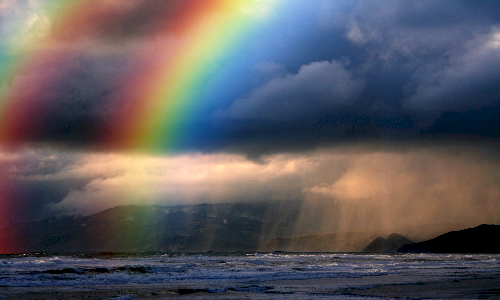
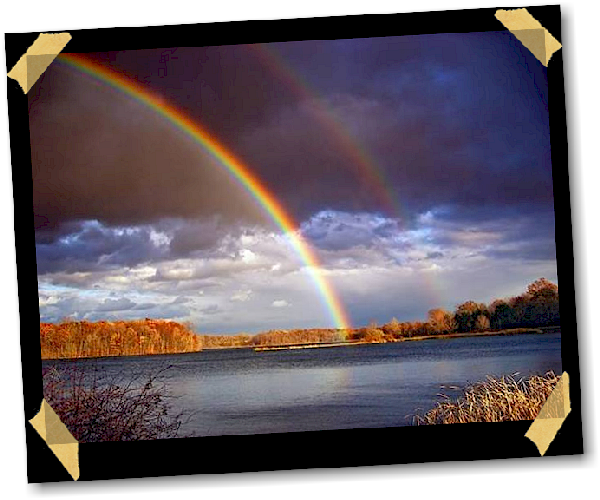
The R A I N B O W has long been a symbol of life, fertility, as a bridge from and to the spirit world, an archer’s bow and of promise and of hope. I like to think of the double rainbow (pictured to your left) as, ‘Promises Made & Promises Kept!”
A rainbow is an optical and meteorological phenomenon that is caused by both reflection and refraction of light in water droplets in the Earth’s atmosphere, resulting in a spectrum of light.
There are many other rare formations of color in the sky as the double rainbow. These other rainbow-like formations include: moonbows, seabows, icebows, sundogs and what I call snowbows.
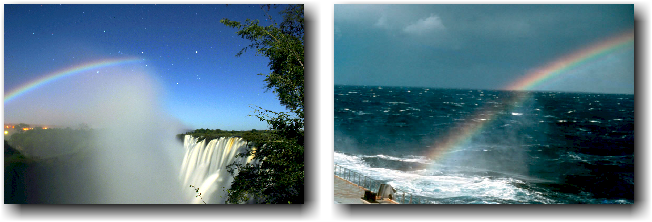
Moonbows form at evening or night with water and if occurring, the bow will be seen away from the moon which passes through the droplets bending the moon’s reflected light from the sun and form the moonbow. What I have personally seen is where mist or spray rising off a waterfall at night, mixes with the light of the moon to form the moonbow.
Seabows or waterbows form from the salt water spray or mist which bends the light of the sun. It may be possible to see both a rainbow and a seabow at the same time, but the seabow’s arch will never line up with that of the rainbow. They are formed separately.
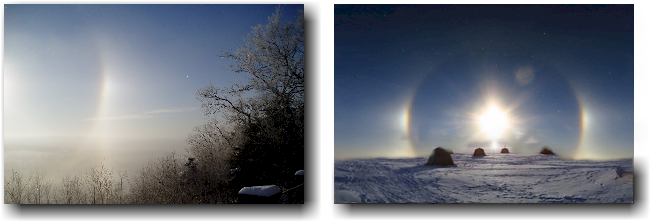
Icebows or halos (from Greek ἅλως; also known as a nimbus, or gloriole. They are an optical phenomenon produced by ice crystals creating colored or white arcs and spots in the sky. Many are near the sun or moon, but others are elsewhere and even in the opposite part of the sky. They can also form around artificial lights in very cold weather when ice crystals called diamond dust, are floating in the nearby air.
Sundogs are commonly made by the refraction of light from plate-shaped hexagonal ice crystals in high and cold cirrus clouds. or during very cold weather. These ice crystals are called diamond dust, and drift in the air at low levels. These crystals act as prisms, bending the light rays passing through them with a minimum deflection of 22°. If the crystals are randomly oriented, a complete ring around the sun is seen — a halo. But often, as the crystals sink through the air, they become vertically aligned, so sunlight is refracted horizontally — in this case, sundogs are seen. They are so-called, as they sometimes appear on opposite sides of the sun or like smaller suns that appear to, ‘dog’ the sun.
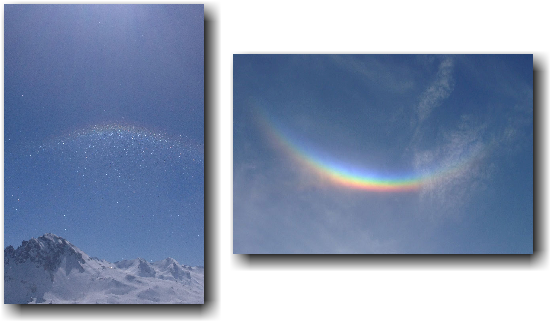
Snowbows may appear when it seems as if snow is falling, but it is actually, more like ice dust or what is referred to as, ‘diamond dust.’ Snowflakes if they melt, turn into water droplets and if these freeze, they will not become flakes again, but small particles of ice (dust) which may appear like falling snow. Snow does not allow light to pass-thru like water and ice crystals. But this floating dust might look like falling snow, so if the colored arc appears, I like to call this a snowbow.
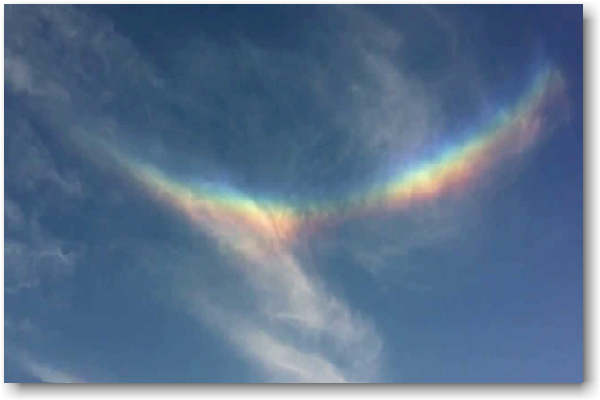
Another rare phenomenon and perhaps my personal favorite is what I call, ‘The Smile of God.’ The smile of God is an upside down rainbow. Technically this is called, the circumzenithal arc, CZA. It is the most beautiful of all the halos. The first sighting is always a surprise. It is like an ethereal rainbow fled from its watery origins and wrapped improbably about the zenith. It is often described as an “upside down rainbow” or as, “a grin in the sky” I like, ‘The Smile of God.”

 gatheringplace.blog