In another post dated October 20, 2014, “Frost on the Punkin,” http://wp.me/p4jGvr-x5, I shared a favorite poem of mine with a video of a feller’ reading it aloud. The poem is, “When the Frost is on the Punkin.” It was written by, James Whitcomb Riley. 1853–1916.
Recently, after going near stir-crazy from the long winter here in New York, it was a beautiful day, the sky blue, the temperature 41º F. and it was time to get out of the house and take a drive!
The temperature and warm sun upon my ageing (or aging) face made it possible, for me to drive with the window slightly ajar and feel the wind through my thinning hair, but the drive along the shore of Lake Ontario and my expectations, for what was in store, made me feel, forever young! Soon, I would meet my cousin and his grandmother, our dear sweet Aunt Anne Magar (Bab’s) [pronounced: Bob’s], for a pancake breakfast.
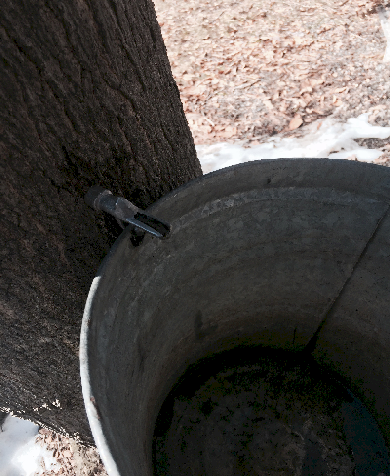
It was not just any ordinary pancake breakfast. Oh, NO, this was the last weekend and the last day, of the New York Maple Syrup Festivals, held all over the state. The breakfast was held by and cooked by, the folks that work or own, this maple tree farm. The breakfast with freshly made maple syrup was, at the facility which taps the sugar maples and boils the sap and makes the syrup.
There was a walking tour among the maple trees, to see the pump house where the collected sap is pumped uphill to the process and boiling center.
The center served as— working areas, museum, educational center and a store to buy 100% certified, pure NY maple syrup and sugar products. Books and CD’s; DVD’s and other items were available. They even had a maple sugar, cotton candy machine, for the ‘kids’ of all ages. 🙂
The owners and staff were on hand to help and answer any questions, people might pose. I had many and they were more than happy, to answer each and every one, to my satisfaction. I must confess that I was tapped, just like a maple tree and my juices and imagination were flowing. I was intrigued by the whole day and process of making maple syrup and sugar! It made me, briefly, forget about missing my wife, who is out of the country, for another two months. 😦
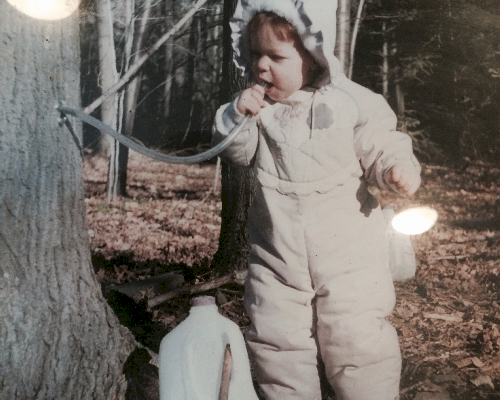
But this short reprieve from winter and from missing my sweet maple tree girl, made me feel not quite as lonely. I was happy to leave winter’s chill, still clinging here and like a little kid and these trees, I was tapped in! 🙂
Intravenous FeedN’ 🙂
Our cousin was previously given about 11 gallons of sap from this very farm and for days and for the first time, he made some maple syrup himself, boiling the sap in pots outside, on his Bar-B-Q grill. He made several jars of syrup and today, he bought a book from the center called, ‘Backyard Sugarin” I liked the word ‘Sugarin’ and I shortened it to just “sugarN” But I could not get this word out of my head. Thought about it the rest of the day and night. This morning, I woke up with it, still on my mind. It reminded me of Riley’s poem and oft’ quoted line from it, “when the frost is on the punkin.” So, just today, it inspired me to write, “When the SugarN’s in the Maples”
Now, I’m not trying to compete with Riley. I make no pretense that it even comes close to being, even a little bit as good as his! But for me, tired of the long cold winter and missing my wife and can’t wait for Spring, it made me sort of, ‘tap’ into spring and it certainly tapped into me. I think Fall and Spring are my favorites of the four seasons. These two seasons fall between, Winter and Summer or Summer and Winter. Winter can be pretty, but I think it’s mostly here to remind me that Spring is coming and Summer is, just the season to enjoy, while waiting on the Fall. So, I wrote and edited and read it aloud to myself, to hear its flow. Then I called Aunt Bab’s and read it to her. She loved it and asked for a copy and promised to commit it to memory, just as she had, ‘When the Frost in on the Punkin.’ I was honored by her asking and am encouraged here, to share this with you, Oh ye’ gatherers together, gathering at the Gathering Place. 🙂
Years ago, a dear friend’s father gave me a gift of his personally worn, loved, washed and a little over-bleached (kind of tie-dye looking cool) pair of what he called his— “Over-hauls.” These are not just anyO’ pair of overalls. They are the crem dela crem of overalls! Thays’ isN’ ‘Big Smith’ overalls, the finest makers of “over-hauls,” since 1916! Promised made and promise kept. The You Tube video of me reading this poem appears, following the the text below. By the way, my excess winter sap (or sugar) did not allow me to fit into my “over-hauls,” I crammed myself into them! :0
I hope you enjoy, “SugarN’s in the Maples.” I hope it gets you ‘flowing!’ 🙂
Thank You, James Whitcomb Riley and Thank You, Aunt Bab’s!
Donnie
It’s SugarN’ Time
“When the SugarN’s in the Maples”
Donnie Hayden, 1953—presently still alive 🙂
When the sugarN’s in the maples and
the taps is in the trees
And you hear the cooN morN doves
a crying in the breezeAnd the peeping of the sparrows and the honkN of the geeseAnd the warmN’s in the morN’in her rising in the eastO, it’s them’s the times a feller is a—putN’ on a smile,And leaves his hibernated caveand gits outside a while,And grabs his hat and forgets his achy knees,
When the sugarN’s in the maples and thetaps is in the treesThere’s something kinda’ hearty-liketho wintern hangs on here—When the nights still chill, but morN’s warm, surely Spring will be so dear—
Of course the grass aint yet green, and no flowers in the bloom
And the gentle rains not yet revealN
what underground’s concealN’
and the robins not yet expected,
but the worms don’t feel neglected
But still, there’s that sweet fragrance in the air,
when sap pots a’boilN’, here and there
Sets my forget of my achy knees
When the sugarN’s in the maples and the
taps is in the trees
The whole scene sets my heart a jumpN’like the sap a runN and the roots, for water pumpNNot time for plantN or growN’, but tahday—Spring’s got no better preacherthan what the maples have to sayCows still relyN on the farmer’s balesand the tractor’s in the barnand they’re dreaming over coffeeand they’re fitN another yarnO, it sets spring’s clock—to ease
When the sugarN’s in the maples and the
taps is in the trees
Then you know the sap is gathered, and the syrup is all madeAnd the taste buds cry— “keep it coming” and winter’s soon to fadeAnd your pancakes and sugarN delights and all the maple sweetsmakes yor’ giddy face a familiar friend to all the strangers it meetsI know no betterN a way to tell it— but if such a thing could beIf anyone or spring or angels need boardin’, and if they were to call on meI’d hand them all over my accommodations and my keys
When the sugarN’s in the maples and the
taps is in the trees
Archive Note:
This post preserves the first public appearance of When the Sugar’s In the Maples, including the author’s reading.
It is archived here as a seasonal record and witness.
The poem may later appear in other formats or collections.
May your every need, be ever met
And your heart, always full
And all the best that’s yet to come,
May it be your crowning jewel
May love and hope ever find you,
sharing these two, with all you meet
And this, ever circling
will never find complete!
Among the many traditions that come with ringing in the new year, the singing of “Auld Lange Syne” has become a custom of almost every gathering at midnight of New Year’s Eve. But what do these words mean?
“Auld Lange Syne” was originally a poem written by Scotland’s favourite poet, Robert Burns in 1788. It was eventually set to the tune of a traditional folk song. The title of the Scottish tune translates to “times gone by” and is about remembering friends from the past and not letting them be forgotten.
Now, at the conclusion of almost every New Year’s celebration, partygoers join hands with the person next to them to form a great circle around the dance floor. At the beginning of the last verse, everyone crosses their arms across their breast, so that the right hand reaches out to the neighbor on the left and vice versa.
I chose the Youtube video (presented below) with Susan Boyle because, I just love her soothing voice, her love for singing, the emotion she projects; I love her heart and simplicity and she was, born in, Blackburn, West Lothian, Scotland.
Susan Boyle, album ‘The Gift’ – Auld Lang Syne
Auld Lang Syne
Should auld acquaintance be forgot
And never brought to mind?
Should auld acquaintance be forgot
And auld lang syne
Chorus:
For auld lang syne, my dear
For auld lang syne
We’ll take a cup o’ kindness yet
For auld lang syne
And surely ye’ll be your pint stowp
And surely I’ll me mine
And we’ll take a cup o’ kindness yet
For auld lang syne
Chorus:
For auld lang syne, my dear
For auld lang syne
We’ll take a cup o’ kindness yet
For auld lang syne
We twa hae run about the braes
An pou’d the gowans fine
But we’ve wander’d mony a weary fitt
Sin’ auld lang syne
Chorus:
For auld lang syne, my dear
For auld lang syne
We’ll take a cup o’ kindness yet
For auld lang syne
Auld Lang Syne
(modern English translation)
Should old acquaintances be forgotten,
And never brought to mind?
Should old acquaintances be forgotten,
And days of long ago!
Chorus:
For times gone by, my dear
For times gone by,
We will take a cup of kindness yet
For times gone by.
We two have run about the hillsides
And pulled the daisies fine,
But we have wandered many a weary foot
For times gone by.
Chorus:
For times gone by, my dear
For times gone by,
We will take a cup of kindness yet
For times gone by.
We two have paddled (waded) in the stream
From noon until dinner time,
But seas between us broad have roared
Since times gone by.
Chorus:
For times gone by, my dear
For times gone by,
We will take a cup of kindness yet
For times gone by.
And there is a hand, my trusty friend,
And give us a hand of yours,
And we will take a goodwill drink (of ale)
For times gone by!
Chorus:
For times gone by, my dear
For times gone by,
We will take a cup of kindness yet
For times gone by.
And surely you will pay for your pint,
And surely I will pay for mine!
And we will take a cup of kindness yet
For times gone by
Chorus:
For times gone by, my dear
For times gone by,
We will take a cup of kindness yet
For times gone by.
When we gather, as friends and family do, we may talk about the good old days (as every generation does). These good old days often, center around high school. These were some of our most memorable, inspiring, confusing, exciting and probably every other adjective thrown in, for every emotion, we often faced NEW or with such great intensity, in about the three years it took us to graduate. We were discovering our voice and place in life, for perhaps, the very first time. We were preparing, for adulthood, manhood, womanhood and hormone-hood! 🙂
Soon, we would be on our own and we could hardly wait to move out of the homes of our parents, our caregivers or the family units we grew up in, for most of our 17 or 18 years of life. Yes, we were preparing to be on our own, have our own place and make our own rules.
We learned new rules and were preparing to move off and on with our individual lives, independent of all others (so we thought or pretended). Choice and change in high school was both exhilarating and frightening, often at the same time. Many ‘firsts’ happened for many of us in high school like: a driver’s license, our first kiss, first love and more. Some of our experiences there were great, some good, some not so good and some, many of us have forgotten or would like to forget. High school was appropriately named. There was no higher school. We were as high as we could go. Some of us, also found, other ways to get high, in high school. 🙂
But, high school was, as high as we could go. After high school, a continued education institution was, generally called a college or a university. But most of us all had a high school. My high school was, simply referred to as, Hickman High School, Hickman High or just Hickman.
David H. Hickman High School, in Columbia, MO, was my high school. It was the high school of our younger sister and our older brother. His two daughters also, attended Hickman. But for our family, it began with our mother and father that most likely met at Hickman and well, the three of us, the children of Calvin and Laura Jean, know how this turned out! 🙂
But Hickman, was not always so named or at its current location.
Public secondary education began in Columbia during the 1880s with the founding of Columbia High School in 1889 at Eighth Street and Rogers. Columbia High School (CHS) began as a two-year course study. In 1895 it increased to three and then four, the following year. Later, it would go back to a three-year high school 10th-12th (sophomores, juniors and seniors) . In 2013, Hickman became a four-year high school again and remains so, still today.
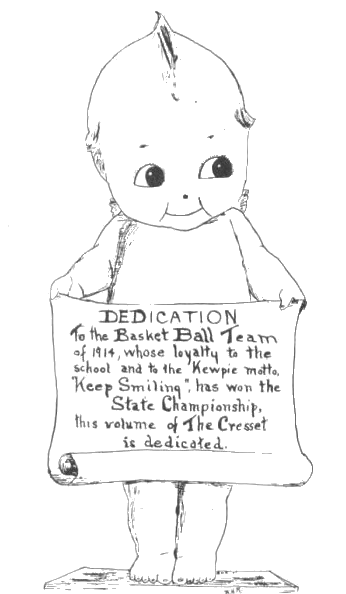
“Overcrowding caused the demolition of the old school and the construction of a new three-story structure at the same site. The new building included the district’s first gymnasium, and the first athletics and music teacher were hired. 1912 saw the first edition of the school yearbook, the Cresset. The school mascot, the Kewpie, appeared for the first time in the Cresset associated with the basketball team “…whose loyalty to the school and to the Kewpiemotto, ‘KeepSmiling,’ has won the State Championship.”
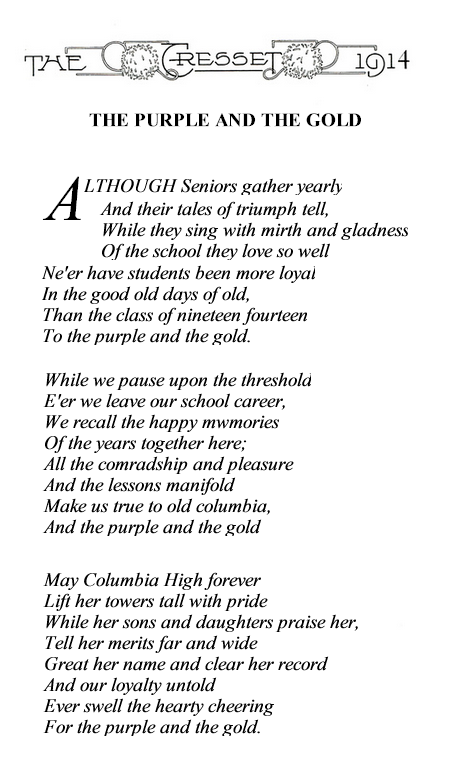
Continued growth made it necessary for a new high school. In 1927, Missouri Legislator and educator, David Henry Hickman, donated his country estate. His namesake high school would replace the former Columbia High School, but it carried with it, many of its traditions including, the ‘Kewpie‘ mascot, the colors, ‘purpleandgold,’ and the yearbook, the ‘Crescent.’ The former downtown property became, Jefferson Junior High School (7th – 9th) until 2013, and then it became, Jefferson Middle School (6th-8th), as it is today.
Hickman continued to grow since 1927, in offerings, clubs, stage and musical productions, recognition, athletics, awards and it remains, to be one of the finest high schools in the United States. Far above the national average, many of its graduates go on to college.
In the 1950’s, Hickman saw the end of racial segregation and was integrated with Fredrick Douglas High School. The influx of more students, necessitated a building boom! More classrooms, special education, vocational work, laboratories, a gymnasium and a swimming pool were added in 1955. This would not be its last expansion!
Some former Notable Hickmans’
Gary Anderson, became a NFL running back with Tampa Bay Bandits (1983-1985), San Diego Chargers (1985-1988), TampaBay Buccaneers (1990-1993), and the Detroit Lions (1993).
Matt Bartle, Missouri state senator
Charley Blackmore, DJ, Creator, owner and webmaster of http://www.kewpie.netJohn M. Dalton, Former Governor of Missouri
Gerry Ellis, Running-back for the Green Bay Packers
Jane Froman, singer/actress
Arlan Gaus, singer/musician blues started – the ‘Blue Slingers’ (my best friend in high school)
Scott Lincoln, After college, Scott moved to New York and worked as an actor in off-broadway. He met a man backstage, who congratulated him on his performance then proceeded to offer him a job on television. The man happened to be Alan Alda and the job would be for ‘Mash.’ Scott moved to California and though never the ‘leading man,’ he knows and has worked with almost every famous actor in the industry. Sometimes credited or not, he is one of the most respected and hardest working actors in the industry. Same age as myself.
Ken Griffin, keyboardist, composer
Kate Hanley, Virginian politician
Dahni Hayden, New York artist, composer, photographer, poet, writer and “The world’s most interested man.” Note: this may be shameless self-promotion, but someone has to do it. 🙂
Jeff Harris, Missouri state representative
Peter Hessler, award winning writer and journalist
Marni Jamie, local ceramic artist in the Columbia are. Same age as myself.
Kenneth Lay, CEO of Enron during the Enron scandal
Rob LaZebnik, writer and co-executive producer for The Simpsons
Claire McCaskill, U.S. Senator (She was one year ahead of me in school)
Scott Murphy, U.S. Congressman from New York
Blake Tekotte, Professional Baseball Player for the Chicago White Sox
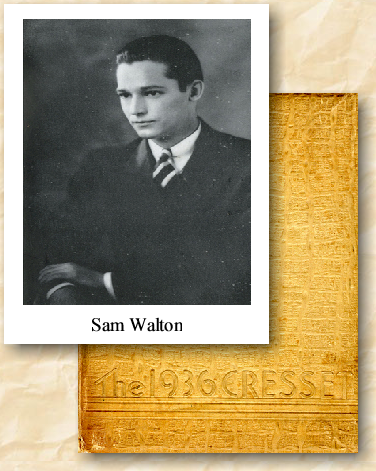
Sam Walton, Founder of Wal-Mart
Who knew, this Sr. Class President, would one day become the world’s richest man!
James “Bud” Walton, brother of Sam Walton and Co-founder of Wal-Mart
Markus Wiechel, Swedish member of parliament
It is interesting that Hickman once educated the future and for a time, the richest man in the world (Sam Walton), one of the most scandalous people (Kenneth Lay), and the “world’s most interestedman,” yours truly! 🙂
Time Magazine’s 2014, Person of the Year CENTURY!Kewpie – From the ‘Crescent’ 1914
🙂
Kewpie
The Kewpie doll has been the mascot of the school for the last 100 years.
Hickman is the only known school in the world with a Kewpie as its mascot.
The name dates back to the basketball season of 1913 -1914 at what was known then as, Columbia High School. Apparently, the school secretary owned a Kewpie doll, as they were popular figurines then, and she kept it on her desk.
At one of the first basketball games in December 1913 she placed her Kewpie doll in the center of the court, and the entire game was played around it without it being broken.
This was somewhat remarkable since the dolls were very fragile. Because it survived the game and brought a victory, it was thereafter considered the good luck mascot.
Whatever the true reason, for selecting this mascot might have been, one HADto have or QUICKLYdevelop some tough athletes with a kewpie for your mascot. Hickman for many years, excelled in several sports.
School Song
On, Sons of Hickman (a.k.a. Kewpies on the March)
On, sons of Hickman
Thru every year,
Praise her and honor her,
And greet her with a cheer,
We’ll shout it!
Kewpies are on the march,
Faithful we’ll always be,
Purple and Gold we’ll carry
To victory!
The school song was written by Mr. C. M. Stookey, a music instructor at Hickman High School in 1944. It was originally called ‘Kewpies on the March.’ The song is featured on the third page of the 1950 Cresset.
School Cheer
Strawberry Shortcake, Gooseberry Pie,
V-I-C-T-O-R-Y!
Are we it? Well, I guess yes!
We’re the Kewpies of H-H-S!
Legends and Strange Facts
As mischievous youth are wont to do, especially at graduation, odd things often occur. Our mother told us that when she graduated (in 1946), a goat was somehow placed on top of the Columbia water tower. No one is quite sure how they got it up there, kept it up there until it was recovered or WHY? Poor goat.
Steam/utility/waste water tunnels were connected together underneath the downtown section of Columbia and underneath the University of Missouri. I know this because I have been in them. From the University of Missouri, they connect with every single building and to their power plant. These tunnels are concrete and eventually, connect to older tunnels made of brick and have arches, downtown Columbia. Legends have it that underneath Hickman, a tunnel or tunnels connect to the old Columbia High School (Jefferson Junior High School/Jefferson Middle School). Many tales both confirmed and unconfirmed, exist concerning the famous ‘Hickman Tunnels.’ Many versions say that the tunnel(s) is or are, in a state of complete or partial disrepair. Others state that it/they is/are still intact. But there is a huge underground facility I can tell you that for certain. Or there was from the fall of 1969-1972 when I was in school there. I am sure this area was below the maintenance area/boiler room was more than large enough to accommodate then, over 2,000+ students and staff. Perhaps it was part of the utility maintenance area (boiler room) and built and used for storage? Maybe it was constructed as a storm or fallout shelter? Whatever its purpose was and if or if not connecting any tunnel or tunnels, it was a great place to skip class as was above the ceiling overlooking the auditorium! For reference to what I mean, think of Phantom of the Opera or watch ‘Home Alone II:)
Legacy
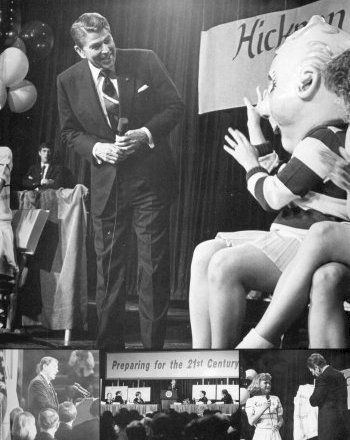
On March 26, 1987, President Ronald Reagan made a special trip to Columbia, Missouri to speak at the National Governors’ Association-Department of Education Conference as well as Fairview Elementary and David H. Hickman High Schools. Hickman had received the Department of Education’s Secondary School Recognition Award, and with six students having been named Presidential Scholars since 1964, Hickman ranked in the top five percent of the nation’s schools. In his address to the assembled students and faculty at Hickman, President Reagan praised the school’s academic quality, saying, in part, “If America is to be what it should be in the 21st century, then it’s going to need a lot of schools, good schools. And Hickman, I’m pleased and proud to tell you, is one of the best.” During the presentation, President Reagan was made an honorary Kewpie and given a school sweatshirt as a gift.
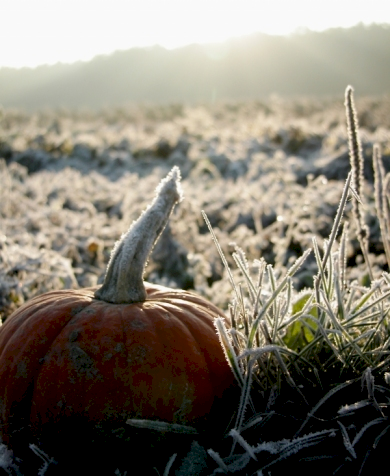
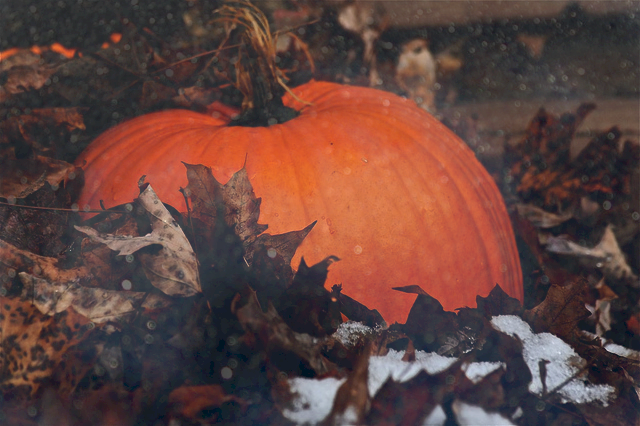
I grew up in the Midwest. We lived in town and had grandparents that lived in the country. City living gave us culture and the advantages which benefit, from higher education. We had the rural roots and common sense, fresh air and produce from the farm. We had the best of both worlds. I especially loved the fall, autumn, falling leaves and colors, crisp apple cider and crisp air, ripening, harvest, plenty and well, just that whole cornucopia idea of, abundance. A familiar phrase to me as a child growing up, just set the whole season into mind and motion. Just a few words gave me the visual promotion or concept of autumn – “when the frost is on the punkin.” Yes, I do know how to spell pumpkin, but “punkin,” is how the word was first pronounced to me. I am not sure where I first heard this. Perhaps it was our mother, from her mother or father, our grandparents? Both of our Mom’s parents were from large farming families so, you might expect the word “punkin” to be proper pronunciation for the farm, country, and the south. Pumpkin would be correct, for the formally educated, the city dwellers, the landlubbers or as a friend refers to me since I am a new transplant to the “country,” a “flatlander.” Well, I think it is pretty obvious as to what “frost on the punkin” means. Pumpkins turn their bright orange color in the fall and while still not winter, the nights and days can be quite cool. Elementary science taught us that something freezes at 32°F. Frost can occur on the ground, on leaves, and yes, even pumpkins at higher temperatures from 32-say-36 or 37°F. So, “frost on the punkin,” means, it’t chilly outside. It’s time for my favorite olympic sport of, raking leaves and jumping into the piles. Not to mention pumpkin eats and drinks, OMG it’s AUTUMN!!! 🙂 I’ve used this phrase for most of my life. Recently, I used it and some people had never heard of it. So, I thought, maybe it is a Midwest or a southern expression; not known to us northerners? Yes, I included myself as a northerner, since I live here in New York, even though I was born and raised in the Midwest. Well, again with the well, well, how deep is this well? Where did this expression come from? I consulted with the oldest trivia, where-did-that-come-from expression expert, our local home-spun-poetry committed to memory aficionado and my fellow poetry-lover kindred spirit, Aunt Anne Magar (Bab’s) [pronounced: Bob’s]. She’s 91 and sharp as a tack. So I put it to her, “Aunt Bab’s,” I said, “have you ever heard the expression, “frost on the punkin?” “Oh, sure,” she said grinning confidently, “It is from a poem. You should look it up!” So I did. It was written by James Whitcomb Riley. 1853–1916
“There is an interesting incident about how Riley’s job was once saved because he had written “When the Frost Is On the Punkin, and the Fodder’s In the Shock.” It is in a book written by Riley’s friend John A. Howland entitled, “James Whitcomb Riley: Prose and Pictures.””
“Riley, as a young Greenfield man, had had a hard time finding a niche in the world since he did not care to follow his father in the practice of law. He sold Bibles, painted signs, entertained in a medicine show, always coming to a dead end. His mother died in 1870 and he felt he could not bear to stay in Greenfield so he went here and there seeking newspaper employment. He ran into E.B. Martindale of “The Indianapolis Journal” whom he later called, “my first literary patron,” who added him to the staff of the paper to write poetry. Some of these poems appeared on the first page of the Journal under the nom de plume “Benjamin F. Johnson of Boone,” supposedly an old farmer. As they were well received, Riley emerged from under his disguise, writing poems such as “When the Frost is on the Punkin.””
“In a short while after Riley joined the paper, a gentleman named Halford was appointed manager of the Journal. One of his first ideas was to cut down on expenses of the paper, and he was considering Riley as his first victim to get the ax. It so happened that a political convention was held in Indianapolis at this very time. One of the candidates nominated for office was a big burly fellow who had never made a speech in his life.”
“When he got up to accept his nomination, his mind went blank and he could not utter a word. The pounding and cheering went on until in desperation he blurted out, “The ticket you have nominated here is going to win “when the frost is on the punkin and the fodder’s in the shock.” This Riley poem had just been published a few days before. in the newspaper.”
“The applause that greeted these words showed that most of these prominent men had read Riley’s work and approved of it. Halford kept him on, and he became an established poet.”
I share the lines with you below and a wonderful oral reading by a man from a You Tube video. I believe you will understand every word below, when you hear him recite it; understand why his father wanted him to share it with strangers each year and you, will understand, “frost on the punkin,” as I now do! Thank You Aunt Bab’s! 🙂 Donnie
“When the Frost is on the Punkin”
James Whitcomb Riley. 1853–1916
When the frost is on the punkin and the fodder’s in the shock,
And you hear the kyouck and gobble of the struttin’ turkey-cock,
And the clackin’ of the guineys, and the cluckin’ of the hens,
And the rooster’s hallylooyer as he tiptoes on the fence;
O, it’s then’s the times a feller is a-feelin’ at his best,
With the risin’ sun to greet him from a night of peaceful rest,
As he leaves the house, bareheaded, and goes out to feed the stock,
When the frost is on the punkin and the fodder’s in the shock.
They’s something kindo’ harty-like about the atmusfere
When the heat of summer’s over and the coolin’ fall is here—
Of course we miss the flowers, and the blossums on the trees,
And the mumble of the hummin’-birds and buzzin’ of the bees;
But the air’s so appetizin’; and the landscape through the haze
Of a crisp and sunny morning of the airly autumn days
Is a pictur’ that no painter has the colorin’ to mock—
When the frost is on the punkin and the fodder’s in the shock.
The husky, rusty russel of the tossels of the corn,
And the raspin’ of the tangled leaves, as golden as the morn;
The stubble in the furries—kindo’ lonesome-like, but still
A-preachin’ sermuns to us of the barns they growed to fill;
The strawstack in the medder, and the reaper in the shed;
The hosses in theyr stalls below—the clover over-head!—
O, it sets my hart a-clickin’ like the tickin’ of a clock,
When the frost is on the punkin and the fodder’s in the shock!
Then your apples all is gethered, and the ones a feller keeps
Is poured around the celler-floor in red and yeller heaps;
And your cider-makin’ ’s over, and your wimmern-folks is through
With their mince and apple-butter, and theyr souse and saussage, too! …
I don’t know how to tell it—but ef sich a thing could be
As the Angels wantin’ boardin’, and they’d call around on me—
I’d want to ’commodate ’em—all the whole-indurin’ flock—
When the frost is on the punkin and the fodder’s in the shock!
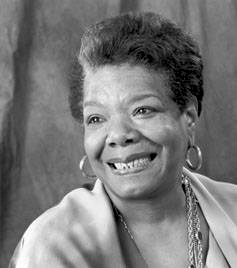
You have sung in your cage, sung in Your release and now You sing, flying free! I cannot offer up Your praise and give words of your many accomplishments. There are many others that knew You, knew You well and that can do the far better telling. I can only shed my own tears of the sad and of the joy. I can only say here, what You mean to me. I call You Maya because, it’s deeply personal and You are this to me, as if I have always known You, though I have never met You, though as if I have! We are not related. Our skins and sins are not the same. We came here to life at different times. All that I may leave here pales, to what, You have left. But I love You and I know You loved me because, You lived!
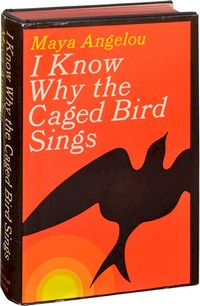
Your first book, ‘I Know Why the Caged Bird Sings,’ set You not upon your path, but it brought many to you and my seeking heart to your path and with your smile, You bid any and all, welcome!
Maya’s 1st book
I always thought of You as my dear and trusted aunt, though I never had the privilege of meeting You. You were born in my home state of Missouri. You lived in Arkansas and I first met of You, when I lived there. I will never forget Your performance in the 1995 movie, ‘How to Make an American Quilt!’ You had only a small part. You did neither write it nor directed it. You were not its narrator. Your character was Anna. You told the story of, “the story quilt.” You are the “story quilt.” You were the master quilter and brought every person into this story. And it is brilliant and so deep and has so many meanings on so many levels. It was more than about a quilt for one woman. It was more than just about women or a movie for women. It was about people, all people. Ignorance makes us all slaves to something or to someone. But together are we freed, WE the many different and beautiful “shreds,” make up ‘An American Quilt!’ ‘An American Quilt,’ is by far, my favorite movie of all time. To me, You were the whole movie! I cannot imagine it being written, directed, acted or presented without You. All the great acting, music and sets were the background. You are its subject. You are the quilting needle; WE are the quilt!
“It’s a story quilt. It’s meant to be read.”
“That summer the Grasse quilting bee did something they’ve never done before. Anna called everyone back and wouldn’t let them go home until they finished the quilt. They all worked [straight through the night] sustained by Anna’s will and gallons of ice tea.”
Young lovers seek perfection.
Old lovers learn the art of sewing shreds together
and of seeing beauty in a multiplicity of patches
“As Anna says about making a quilt, you have to choose your combination carefully. The right choices will enhance your quilt. The wrong choices will dull the colors, hide their original beauty. There are no rules you can follow. You have to go by your instinct. And you have to be brave.”
excerpts from the transcript: ‘An American Quilt’
I hear You and see You and feel You in every frame of the whole movie and in the following video clip.
Your last Tweet on Twitter:
Your last personal Facebook post was typical of, your concern for others
Maya’s FB Profile
Maya Angelou
May 26, 2014
“And now we come to the day [Memorial Day] where we can honor the brave men and women who have risked their lives to honor our country and our principles. Our history is rife with citizens who care and who are courageous enough to say we care for those who went before us.”
You earned three Grammys, spoke six languages, and were the second poet in history to recite a poem at a presidential inauguration. You received two Presidential Medals of Honor from two separate presidents, one for Art and the most important, for Freedom.
On Thursday, May 28, 2014, you took your last breath and I was breathless when I knew.
On your Facebook page:
Your FB profile
Statement from Dr. Maya Angelou’s Family:
Dr. Maya Angelou passed quietly in her home before 8:00 a.m. EST. Her family is extremely grateful that her ascension was not belabored by a loss of acuity or comprehension. She lived a life as a teacher, activist, artist and human being. She was a warrior for equality, tolerance and peace. The family is extremely appreciative of the time we had with her and we know that she is looking down upon us with love.
Guy B. Johnson
You were a beautiful young girl, a beautiful young woman, a beautiful woman, and a beautiful lady in Your glorious sunset! There is no place for a beautiful mind to be shone, than shining out and upon, from within!
My favorite poem of Yours, I will share here to follow. You meant a lot to me personally, and I will greatly miss Your presence on this earth and in the life that I have left!
Still I Rise
by Maya Angelou, 1928 – 2014
You may write me down in history
With your bitter, twisted lies,
You may trod me in the very dirt
But still, like dust, I’ll rise.
Does my sassiness upset you?
Why are you beset with gloom?
‘Cause I walk like I’ve got oil wells
Pumping in my living room.
Just like moons and like suns,
With the certainty of tides,
Just like hopes springing high,
Still I’ll rise.
Did you want to see me broken?
Bowed head and lowered eyes?
Shoulders falling down like teardrops,
Weakened by my soulful cries?
Does my haughtiness offend you?
Don’t you take it awful hard
‘Cause I laugh like I’ve got gold mines
Diggin’ in my own backyard.
You may shoot me with your words,
You may cut me with your eyes,
You may kill me with your hatefulness,
But still, like air, I’ll rise.
Does my sexiness upset you?
Does it come as a surprise
That I dance like I’ve got diamonds
At the meeting of my thighs?
Out of the huts of history’s shame
I rise
Up from a past that’s rooted in pain
I rise
I’m a black ocean, leaping and wide,
Welling and swelling I bear in the tide.
Leaving behind nights of terror and fear
I rise
Into a daybreak that’s wondrously clear
I rise
Bringing the gifts that my ancestors gave,
I am the dream and the hope of the slave.
I rise
I rise
I rise.
Cradle
by Dahni
How does one summarize the impact of a single life? Indeed, there have been countless books penned, poems and paintings that have tried to capture this deep enigma. Perhaps the smallest sentence to have ever seized all the emotion of loss comes from the Bible,
“Jesus Wept!”
William Shakespeare from ‘King Lear,’ concluded a single life simply and plainly with the words,
“He died!”
But the things penned, the poems, the paeans, and paintings all try to show the eons of time, events and unique forming that brought forth the birth of a single life. And then they try to show the waves and connections and spheres of influence from all the moments and all the years of a single life. And thus a summing up of all that are touched by this single life may simply and plainly conclude –
They Lived!
No one can escape tears sometimes. Sometimes these droplets of one’s measured life are of great joy. Sometimes these droplets of one’s measured life are of great sorrow. The push of sorrow and the pull of joy is this not like a crib and are we not cradled of love? A life enters and exits, but leaves a cradle rocking. The push and pull continues. Turn the page, keep reading. Pen, poem and paint. Rock the cradle, for the point is
We live!
Note: a “paean” – any song of joy, praise or triumph
Even more than my ‘Cradle’ poem, You taught me to always trust love –
“Have enough courage to trust love one more time
and always one more time.”
Maya Angelou
Even more than my ‘Cradle’ poem, You taught me that all of us are shackled or we bear the scars of something that enslaves. But my favorite words from You are, only two.
“Love Liberates”
Maya Angelou
You sang in Your cage. You sang when Your caged was opened. You sing now in freedom’s flight. Many will fly because, of You.
Today marks the official, 43rd year of observing Memorial Day, as a federal holiday beginning in 1971. It could be the 149th, 148th, 147th or 146th, depending on who you are, what you believe and where you are from. There are no less than a dozen cities, organizations and persons that it has been attributed to or claim it and that they, he or she was the first to come up with the name and or to celebrate the event for the first time. Indeed, a study or personal research undertaken, as to the histories and origins of Memorial Day, will reveal very much, interesting information. That last sentence was highly understated!
The stories range from it began in the south to no, it was the north from after the American Civil War. Some say no, it began earlier than that. Some say it started in Columbus, Georgia, but Columbus, Mississippi, highly disagrees with that, because they say they were first.
Francis Miles Finch (June 9, 1827 – July 31, 1907) was an American judge, poet, and academic associated with the early years of Cornell University. Finch wrote poetry throughout his life. Perhaps his best known poem, “The Blue and the Gray”, written in remembrance of the dead of the American Civil War, was inspired by a women’s memorial association in Columbus, Mississippi, who on April 25, 1866 tended the graves of Confederate and Union soldiers, treating the dead as equals despite the lingering rancor of the war.
The Blue and the Gray
By Francis Miles Finch
By the flow of the inland river,
Whence the fleets of iron have fled,
Where the blades of the grave-grass quiver,
Asleep are the ranks of the dead:
Under the sod and the dew,
Waiting the judgment-day;
Under the one, the Blue,
Under the other, the Gray.
These in the robings of glory,
Those in the gloom of defeat,
All with the battle-blood gory,
In the dusk of eternity meet:
Under the sod and the dew,
Waiting the judgment-day;
Under the laurel, the Blue,
Under the willow, the Gray.
From the silence of sorrowful hours
The desolate mourners go,
Lovingly laden with flowers
Alike for the friend and the foe:
Under the sod and the dew,
Waiting the judgment-day;
Under the roses, the Blue,
Under the lilies, the Gray.
So with an equal splendor,
The morning sun-rays fall,
With a touch impartially tender,
On the blossoms blooming for all:
Under the sod and the dew,
Waiting the judgment-day;
Broidered with gold, the Blue,
Mellowed with gold, the Gray.
So, when the summer calleth,
On forest and field of grain,
With an equal murmur falleth
The cooling drip of the rain:
Under the sod and the dew,
Waiting the judgment-day;
Wet with the rain, the Blue,
Wet with the rain, the Gray.
Sadly, but not with upbraiding,
The generous deed was done,
In the storm of the years that are fading
No braver battle was won:
Under the sod and the dew,
Waiting the judgment-day;
Under the blossoms, the Blue,
Under the garlands, the Gray.
No more shall the war cry sever,
Or the winding rivers be red;
They banish our anger forever
When they laurel the graves of our dead!
Under the sod and the dew,
Waiting the judgment-day;
Love and tears for the Blue,
Tears and love for the Gray.
Though this is a beautiful poem and memory, some believe Memorial Day was inspired by a southern woman and others say it was a northern military officer. Then there is a town in my state, Waterloo, NY that have honored the day since May 5th, 1866. To this, president Lyndon Johnson directed the federal government to recognize Waterloo, NY in 1971, as the birthplace of Memorial Day? You cannot say that the president, a southerner, was biased, being Waterloo, NY, is, in the north. But hold on, wait just a minute.
Some believe and would like the rest of us to believe that the ceremonies in April of 1865, might have begun what has come to be known as Memorial Day? Remember Fort Sumter? It was a fort off the coast of Charleston, South Carolina, long used in defense of the city. For all practical reasons, Fort Sumter is where the American Civil War began. It seemed kind of fitting to include it in the memory, after Lee’s surrender at Appomattox, which unofficially ended the war between the states. Indeed, the same year, the flag of the United States would fly over Fort Sumter. All kinds of ceremonies were planned and implemented on the island, to honor the dead, the end of hostilities and the long reconciliatory process which was beginning, between the north and the south. This all happened on April 15, 1865. Later the same day and this same year, in Washington, D.C., president Abraham Lincoln was assassinated at Ford’s Theater.
But hold on again, wait just another minute. What about the story of prisoners of war that had died in captivity in Charleston, South Carolina and were honored on May 1, 1865? Was this the beginning of Memorial Day?
“During the war, Union soldiers who were prisoners of war had been held at the Charleston Race Course and were hastily buried in unmarked graves. Together with teachers and missionaries, black residents of Charleston organized a May Day ceremony, covered by the New York Tribune and other national papers. The freedmen cleaned up and landscaped the burial ground, building, an enclosure and an arch labeled, “Martyrs of the Race Course.” Nearly ten thousand people, mostly freedmen, gathered on May 1 to commemorate the war dead. Involved were about 3,000 school children newly enrolled in freedmen’s schools, mutual aid societies, Union troops, black ministers, and white northern missionaries. Most brought flowers to lay on the burial field.”
Professor David W. Blight of the Yale University Department of History, described the day during part of his lecture, ‘The Beginning of Memorial Day,’
“This was the first Memorial Day. African Americans invented Memorial Day in Charleston, South Carolina. What you have there is black Americans recently freed from slavery announcing to the world with their flowers, their feet, and their songs what the war had been about. What they basically were creating was the Independence Day of a Second American Revolution.”
Of course, there remain many that want to dispute professor Blight’s claim, but if it were not for his discovery of this information, nearly lost and possibly suppressed, we would not even have it to consider. Did you know this former racetrack-turned open air field cemetery, still exists or efforts are being made to include this hallowed place as, an historic landmark? I did not until very recently.
On and on the stories and claims go, perhaps without ending and without number. But it seems the importance or meaning of the day, is lost on who said what first, made it first, and inspired it first.
At this point, what exactly do we know? We know that somewhere, sometime, someone merged Decoration Day with Memorial Day. It was merged because, after the change, people would still ‘decorate’ the graves of the fallen, but the word ‘memorial’ was more appropriate, for the reason they they did this. So it seems the connection was to honor the dead that fell during the American Civil War by decorating their graves. But we know that today, Memorial Day has expanded.
Many believe the name change from “Decoration Day” to “Memorial Day,” was first used in 1882. But it still was not a Federal Law until 1967. On June 28, 1968, the Congress passed the Uniform Monday Holiday Act, which moved four holidays, including Memorial Day, from their traditional dates to a specified Monday, in order to create a convenient, three-day weekend. The change moved Memorial Day from its traditional May 30th date to the last Monday in May.
Law smaw, many states rejected this change until years later, when all 50 states were finally in compliance. Then there are those that still don’t like the date of the last Monday of the month of May. They would prefer the date being set on a more traditional date of May 30th, no matter what day of the week it may fall on. Congress has been repeatedly petitioned to make this change, even among its own members, but to no avail. Besides, if this were to happen, it would disrupt Memorial Day business, observed by most businesses because, this is the unofficial beginning of summer. Hmmm, what was really important, the day itself or another day off and part of another long weekend off and the opportunity for businesses to sell us their stuff from out of their stock and off their shelves?
Memorial Day expanded to include fallen soldiers, for all wars and conflicts since the American Civil War. Some did not like that because, living soldiers were not included. So Veterans Day was added for all veterans, living and deceased, for all wars. Veteran’s Day is on Tuesday, November 11 (this year 2014). But I bet more than many turn this into a four-day weekend, to do more stuff, get more stuff and to sell more stuff.
Memorial Day weekend has expanded to associate with the Labor Day weekend beginning, Monday September 1st (this year 2014). What is the association? Most people, businesses and organizations, with private or public swimming pools, open their pools around Memorial Day and close them down, after Labor Day.
Memorial Day weekend has expanded to associate with, the Indianapolis 500 and the Coca Cola 6oo races. These car racing events have for some time, been run on Memorial Day.
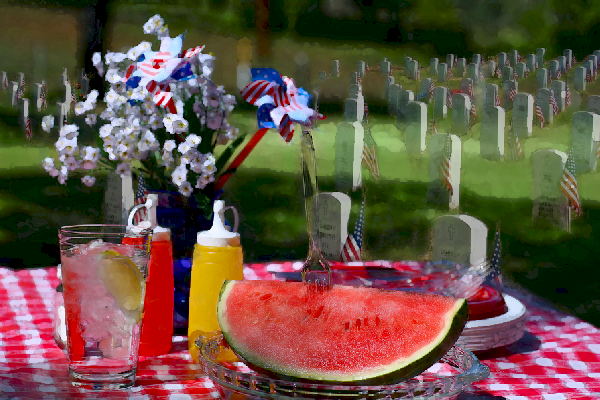
Somehow, Memorial Day was expanded to include all deceased members of families and friends and associates. People everywhere started decorating other graves besides those of soldiers. Then Memorial Day expanded to include picnics, gatherings of friends and families, businesses, other groups and of course, including barbecues!
Around the 16th century in England, the word potluck is said to have first been used. In the writings of Thomas Nashe, he defined this as, “food provided for an unexpected or uninvited guest, the luck of the pot.” In the 19th or 20th century, this potluck or sometimes called potlatch, was considered a communal or community meal, where people brought their own food. To the native Irish, this “luck of the pot,” had no particular menu, but was shared with many people and with many types of food, from whatever you had on hand because, quite often, this was the only pot people had to cook with. So many got together to use it and share the food together. This could have been neighbors, friends, families or all of them. This could have taken on the character of an extended family or a family reunion. Some people would often travel hundreds of miles to reconnect or with friends and families. They would gather on a certain day (like Memorial Day), decorate the graves of loved ones and renew their relationships or meet other new friends and family members. Sometimes, there could have been a religious service at the site and often this would follow with a “dinner on the ground.” Yes, at the cemetery, they would spread sheets or tablecloths on the grass or set up tables and “pass the pot,” sharing together what each brought to share. Now many believe this practice started way before the American Civil War so therefore, it predates any other origin of Memorial Day. But there are plenty of people around to dispute that claim or idea!
So what do we know for sure? We know that Memorial Day has expanded to include a lot of people and stuff. But what actually is Memorial Day? What is its purpose? I dunno, so I looked up the word “memorial,” in the dictionary.
The word memorial is a noun. It’s first definition, found in most dictionaries is, something similar to that which follows:
“something designed to preserve the memory of a person, event, etc., as a monument or a holiday.’
Origin:
1350-1400; Middle English < Late Latin memoriāle, noun of neuter of Latin memoriālis for or containing memoranda. belonging to remembrance
Old French memorie, from Latin memoria, from memormindful”
In the least common denominator, memorial comes from the word memory and is connected to ‘being mindful.’ What should we be memorializing? For what purpose should we remember. keep in our memory and be mindful of?
In a previous post on this blog ‘ON: ANZAC DAY, I wrote about my recent experiences in Australia. You can can read it for the first time or again if you so choose, but it began for me, an evolution if you will, for what Memorial Day means to me now.
Here at The Gathering Place, me and the Mrs., which is pretty poor, improper or just bad English (but the 2 m’s may make it easier to recall) or properly, the Mrs. and I, are spending the day much like many others. We started by attending our first Memorial Day Parade, in our new home-based area of, Macedon, NY. As relatively new members of this community, we wanted to become more involved. We waited at the cemetery, as the parade approached.
We connected with new friends and reconnected with old friends. We walked into the cemetery and were part of the short service that was followed by free hotdogs, chips and drinks up at the Macedon Center.
But the service began with a moment of silence, honoring those soldiers that were buried in this field. Next, there was an oral reading of a poem I had not heard before. The poem was written by Archibald MacLeish, a poet who served in the U.S. Army in World War I:
The Young Dead Soldiers
by Archibald MacLeish
The young dead soldiers do not speak.
Nevertheless, they are heard in the still houses:
who has not heard them?
They have a silence that speaks for them at night and when the clock
counts.
They say: We were young. We have died.
Remember us.
They say: We have done what we could
but until it is finished it is not done.
They say: We have given our lives but until it is finished no one can
know what our lives gave.
They say: Our deaths are not ours: they are yours, they will mean what
you make them.
They say: Whether our lives and our deaths were for peace and a new hope
or for nothing we cannot say, it is you who must say this.
We leave you our deaths. Give them their meaning.
We were young, they say. We have died; remember us
This was followed by a short prayer in thanks for the freedom that we there and we everywhere, are charged with as overseers and preservers of this freedom. The service concluded with a 21 gun salute to those fallen.
Both my wife Susan and I have had members of our individual families and mutual friends that served in the military. We have friends and family that are presently, serving in the military. We are quite used to and understand, “extended families.” These friends and families and soldiers became, ours and my friends and families and soldiers!
My manner for quite sometime has been, to remove my hat and extend my right hand to any soldier I meet, to say thank you, for their service to our country. All of theses men and women either paid the ultimate sacrifice or were or are willing, to give their lives, for what they believed and believe is in defense of this nation. But what does that mean? What is this nation? How are we any different than any other person upon the face of the earth, living or dead? Isn’t it that we have placed into writing that “all…are equal,” and all have, “certain unalienable rights that among these are Life, Liberty and the Pursuit of Happiness?” Is this not the cry of every heart; of every man, woman and child – past, present and future for, the freedom to exercise these rights?
For Susan and I like many people, we will put something on the grill later and do some yard work, visit with and talk to friends and family. I will personally reflect upon what Memorial Day has now come to mean to me.
I will change my greeting to any known solidier I may meet. I will thank them for their part is keeping us all free to enjoy Life, Liberty and the Pursuit of Happiness. And I will extend this greeting to you, wherever you may be or whenever we may meet. For you too are, a defender, protector and an overseer of this freedom we all here, are here by rights to enjoy.
To truly honor our dead, we may continue to decorate their graves, get together, barbecue, open or go to a pool, and all the things we do, do on Memorial Day, but How SHALL WE HONOR THEM the BEST!
Let us go forth this Memorial Day, for all time, in the memory of and mindful of that each of us contribute or take part in the attempts to destroy freedom. If we cannot all, always agree, let us agree to disagree and part as friends and family, but let us each continue to preserve the path in peace, and decorate, and remember that we each are preservers of the freedom to enjoy, Life, Liberty and the Pursuit of Happiness!
So to you, anyone that reads this or that I meet today or that I may meet one day, I say THANK YOU! Thank you for taking care of all our freedom to all our rights for, Life, Liberty and the Pursuit of Happiness!!! Thank You!
Well, I know about house warming and barn raising. I even know “Hi Ho” from ‘Snow White and the Seven Dwarves, but I never heard of a silo-wering, until today! 🙂
Our neighbor across the road that owns all the farm land around here, as far as eye can see, has three silos. This morning, I received a phone call from his wife. “Don’t get excited,” she said, “If you see car-gawkers along the road or people standing in the top of one of our silos by the barn, we’re having it taken down.”
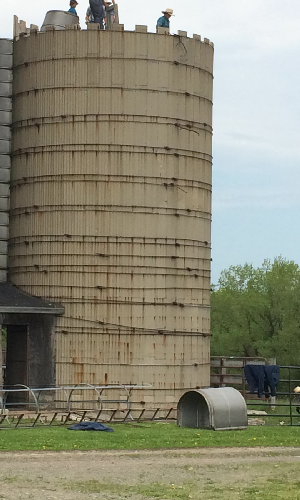
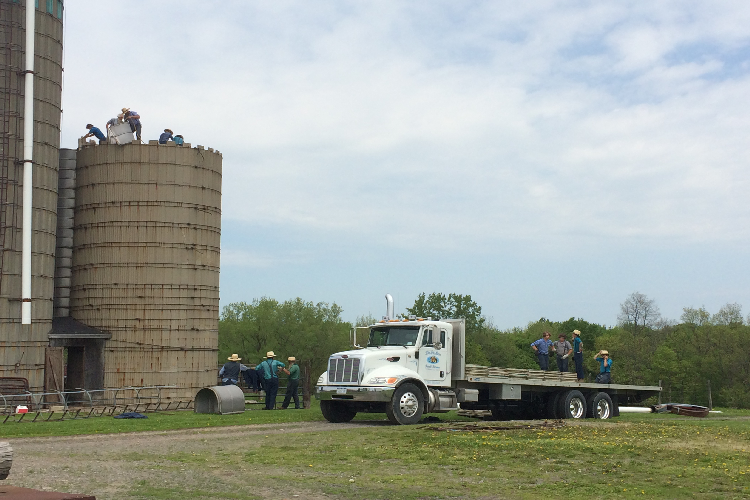
Sure enough, I looked across the road and could see men, “standing in the top,” of one of their silos, just like she said. I had to go for a closer look and snap some pictures.
Silo-wering
This silo being taken down was about the same size as the one you see to the left, in the next picture. It had not been used for some time and it did not have a roof, long lost to some wind storm in the past.
The people were a group of Amish, contracted to de-construct the silo.
You can tell they are Amish by their familiar clothing of blue trousers, lighter blue shirts, suspenders and straw hats. I could see the beards on the men and hear their speech, which sounded German or perhaps, Pennsylvania Dutch.
The picture to the left was shot around 10:00 am and already, they had removed almost a 1/3 of the structure. They probably started around seven this morning.
There were three groups with each having a certain job to do.
The men standing inside the structure (somehow), would remove any metal and throw it down. Then they would go around the circumference and remove the concrete panels about 3′ X 1′ X 2″ thick.
The concrete panels probably weighed at least 100 pounds.
Then the leader on top would call out to the men standing on the ground to stand clear and then the would toss down the panels. They would yell clear and stop dropping materials.
The men on the ground would go pick up the pieces and take them to the truck and lay them on the bed. Then the leader on the ground would call out to the men on the silo, that they were clear.
There was one man on the truck bed that seemed to be the team leader or supervisor. The rest were young men around 12-15 I guess. They would stack the concrete panels on the truck bed. I asked one of the young men what they were going to do with the material and I was told they were going to use it to re-construct this silo, somewhere else.
They are amazing to watch how the work together and just keep moving!
Teamwork
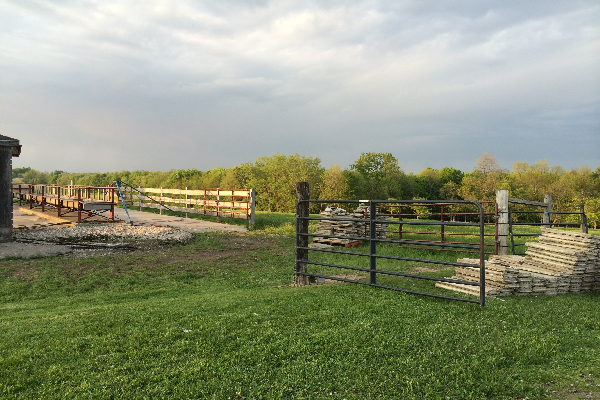
This went on all day until they finished the job. Each group rested between their specific jobs. This was very interesting and very efficient. I am amazed at their work ethics, how they kept moving, worked together, resting only they were not directly involved. I can imagine that other groups or companies might take days to do this job and probably with a lot of broken materials. But the Amish completed this job in one day. The flat bed truck was fully loaded. The only thing left was some concrete panels stacked up and the concrete pad the silo stood on.


















 gatheringplace.blog