May your every need, be ever met
And your heart, always full
And all the best that’s yet to come,
May it be your crowning jewel
May love and hope ever find you,
sharing these two, with all you meet
And this, ever circling
will never find complete!
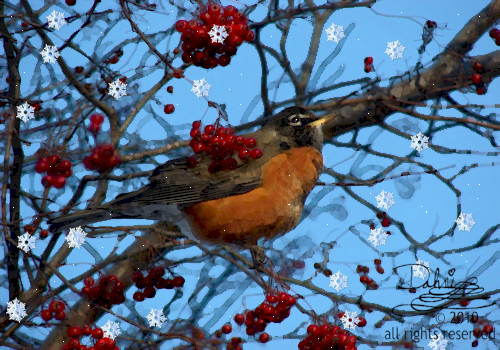
The American Robin is, a more sure harbinger and prognosticator of spring, than Punxsutawney Phil the ground hog, could ever be, in his or her, wildest dreams.
Robins are actually, part of the family of thrushes. They received their familiar name from homesick European settlers in the United States, many years ago. They were reminded of their beloved and familiar little Robin Red-breast, which has a color pattern brighter, but somewhat similar to our robin, even though the two are, not closely related.
Years ago, there was a median strip between our home (then) and our neighbor’s property. In the middle of this strip of land was a Hawthorne tree with long and potentially hurtful thorns. Trust me they hurt, having been pricked by them, more than a few times. The berries are bright red orange and often stay on the tree throughout the winter. The reason for this is quite simple. Their berries are not considered to be, culinary fowl fare or bird yum yums. 🙂
Most wintering critters and birds don’t care for them, that is, until one snowy wintry, February morning. I happened to look outside our bedroom window and right below in this Hawthorne tree was, at least a hundred robins. In about a half an hour, they picked the tree clean. There was not a single berry left. I was astounded!
I had never seen so many robins before and I did not know they would group like this. So, I did some research.
I suppose, I never really thought about where robins go in the winter? I guess I never entertained the idea that they migrate, but they do. Curiously, first of all, some, for some unknown reason, will winter farther up north in Canada (We live in NY). But others, will migrate thousands of miles, from Vancouver Island to as far south as, Guatemala. Some will just hang around where they are.
Robins are of only, just a few type of birds that change their diet. They will eat nuts, seeds and berries (even those nasty Hawthorne berries), insects and grubs and their favorite delicacy, earthworms. Obviously in February, it was still a little cold for earthworms. But the interesting thing I have come to understand about the robins I saw in February is, they were all male. The males return before their females to begin building their nests, scoping out new or defending their territory. And how do they defend their turf – by singing, sometimes fighting, but a good song seems to be, what works best, most of the time.
After the male robins first appear, the spring rains begin soon thereafter. When the grounds become saturated, the earthworms come up for air. From the time the males show up and the rains fall is, around two weeks. Right on cue, about two weeks after the males, the females arrive hungry from the long flight and earth worms are easy to find. Contrary to what I thought and perhaps many others as well, robins do NOT hear the earthworms underground, they see them on the top of the waterlogged soil. I know, we’ve all seem them pecking on the ground when it looks like there’s nothing there, don’t they really hear the worms? Just remember, their eyesight is far superior to ours. They can see the smallest movement of leaves and earth and KNOW, something alive is moving!
So dear friends and family of, The Gathering Place, robins are, the sure sign that spring has sprung! 🙂
Robin song mp3 on SoundCloud (may not work on Apple devices)
Robin Song on YouTube
The following poem which inspired by these robins was, posted on another one of my blogs at: Dahni Daily, Februrary, 21, 2010. It was written right around the time the robins first appeared in the Hawthorne tree. They did come back the next year, but only around 30. That was the last time I saw them in such numbers or in that tree. We moved to where we live now at: The Gathering Place. But we still see robins here. I can’t wait to see them soon and report that spring here, has definitely arrived! I hope you enjoy the following poem.
Among the many traditions that come with ringing in the new year, the singing of “Auld Lange Syne” has become a custom of almost every gathering at midnight of New Year’s Eve. But what do these words mean?
“Auld Lange Syne” was originally a poem written by Scotland’s favourite poet, Robert Burns in 1788. It was eventually set to the tune of a traditional folk song. The title of the Scottish tune translates to “times gone by” and is about remembering friends from the past and not letting them be forgotten.
Now, at the conclusion of almost every New Year’s celebration, partygoers join hands with the person next to them to form a great circle around the dance floor. At the beginning of the last verse, everyone crosses their arms across their breast, so that the right hand reaches out to the neighbor on the left and vice versa.
I chose the Youtube video (presented below) with Susan Boyle because, I just love her soothing voice, her love for singing, the emotion she projects; I love her heart and simplicity and she was, born in, Blackburn, West Lothian, Scotland.
Susan Boyle, album ‘The Gift’ – Auld Lang Syne
Auld Lang Syne
Should auld acquaintance be forgot
And never brought to mind?
Should auld acquaintance be forgot
And auld lang syne
Chorus:
For auld lang syne, my dear
For auld lang syne
We’ll take a cup o’ kindness yet
For auld lang syne
And surely ye’ll be your pint stowp
And surely I’ll me mine
And we’ll take a cup o’ kindness yet
For auld lang syne
Chorus:
For auld lang syne, my dear
For auld lang syne
We’ll take a cup o’ kindness yet
For auld lang syne
We twa hae run about the braes
An pou’d the gowans fine
But we’ve wander’d mony a weary fitt
Sin’ auld lang syne
Chorus:
For auld lang syne, my dear
For auld lang syne
We’ll take a cup o’ kindness yet
For auld lang syne
Auld Lang Syne
(modern English translation)
Should old acquaintances be forgotten,
And never brought to mind?
Should old acquaintances be forgotten,
And days of long ago!
Chorus:
For times gone by, my dear
For times gone by,
We will take a cup of kindness yet
For times gone by.
We two have run about the hillsides
And pulled the daisies fine,
But we have wandered many a weary foot
For times gone by.
Chorus:
For times gone by, my dear
For times gone by,
We will take a cup of kindness yet
For times gone by.
We two have paddled (waded) in the stream
From noon until dinner time,
But seas between us broad have roared
Since times gone by.
Chorus:
For times gone by, my dear
For times gone by,
We will take a cup of kindness yet
For times gone by.
And there is a hand, my trusty friend,
And give us a hand of yours,
And we will take a goodwill drink (of ale)
For times gone by!
Chorus:
For times gone by, my dear
For times gone by,
We will take a cup of kindness yet
For times gone by.
And surely you will pay for your pint,
And surely I will pay for mine!
And we will take a cup of kindness yet
For times gone by
Chorus:
For times gone by, my dear
For times gone by,
We will take a cup of kindness yet
For times gone by.
When I was a child, our grandmother that we her ‘kidlits’ (as she called us), called her Nanny. This name was probably due to the trouble my brother had with the ‘g’ and ‘r’ sounds as in grandmother, grandma and granny. So Nanny just stuck.
Well Nanny used to sing this little song called ‘Jacky Frost.’ I loved it and still sing it, especially when the weather gets colder and/or as the holidays approach.
I married a music teacher with a master’s in music. She taught K-6 for over 25 years. But she had never heard of this song before I sang it. So I taught a teacher at least this one thing. 🙂
To my wife Susan’s credit, she was recently able to find the words and the music for this little known, perhaps forgotten, but enjoyable little tune for children of all ages. I will share it here for all, just in time for the holidays.
The lyrics to this song were adapted from the poem, “Jacky Frost”, by Laura E. Richards. You can find this poem in the collection “Tirra Lirra Rhymes Old and New” by Laura E. Richards.
The music was composed by Eleanor Smith, who included the song in her music textbooks designed for children. These textbooks are over 100 years old. You can find the song in “The Common School Book of Vocal Music” by Eleanor Smith. She adapted the poem just slightly to fit her melody.
Jacky Frost
Jacky Frost, Jacky Frost,
Came in the night;
Left the meadows that he crossed,
All gleaming white.
Painted with his silver brush
Every window-pane.
Kissed the leaves and made them blush,
Blush and blush again.
Jacky Frost, Jacky Frost,
Crept around the house,
Sly as a silver fox,
Still as a mouse.
Out our little Jenny came,
Blushing like a rose;
Up jumped Jacky Frost,
And pinched her little nose.
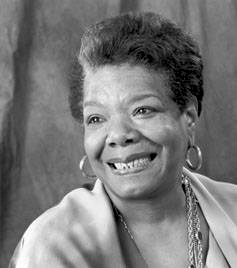
You have sung in your cage, sung in Your release and now You sing, flying free! I cannot offer up Your praise and give words of your many accomplishments. There are many others that knew You, knew You well and that can do the far better telling. I can only shed my own tears of the sad and of the joy. I can only say here, what You mean to me. I call You Maya because, it’s deeply personal and You are this to me, as if I have always known You, though I have never met You, though as if I have! We are not related. Our skins and sins are not the same. We came here to life at different times. All that I may leave here pales, to what, You have left. But I love You and I know You loved me because, You lived!
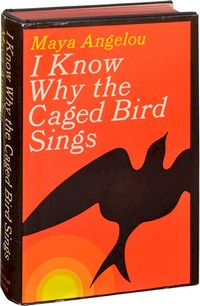
Your first book, ‘I Know Why the Caged Bird Sings,’ set You not upon your path, but it brought many to you and my seeking heart to your path and with your smile, You bid any and all, welcome!
Maya’s 1st book
I always thought of You as my dear and trusted aunt, though I never had the privilege of meeting You. You were born in my home state of Missouri. You lived in Arkansas and I first met of You, when I lived there. I will never forget Your performance in the 1995 movie, ‘How to Make an American Quilt!’ You had only a small part. You did neither write it nor directed it. You were not its narrator. Your character was Anna. You told the story of, “the story quilt.” You are the “story quilt.” You were the master quilter and brought every person into this story. And it is brilliant and so deep and has so many meanings on so many levels. It was more than about a quilt for one woman. It was more than just about women or a movie for women. It was about people, all people. Ignorance makes us all slaves to something or to someone. But together are we freed, WE the many different and beautiful “shreds,” make up ‘An American Quilt!’ ‘An American Quilt,’ is by far, my favorite movie of all time. To me, You were the whole movie! I cannot imagine it being written, directed, acted or presented without You. All the great acting, music and sets were the background. You are its subject. You are the quilting needle; WE are the quilt!
“It’s a story quilt. It’s meant to be read.”
“That summer the Grasse quilting bee did something they’ve never done before. Anna called everyone back and wouldn’t let them go home until they finished the quilt. They all worked [straight through the night] sustained by Anna’s will and gallons of ice tea.”
Young lovers seek perfection.
Old lovers learn the art of sewing shreds together
and of seeing beauty in a multiplicity of patches
“As Anna says about making a quilt, you have to choose your combination carefully. The right choices will enhance your quilt. The wrong choices will dull the colors, hide their original beauty. There are no rules you can follow. You have to go by your instinct. And you have to be brave.”
excerpts from the transcript: ‘An American Quilt’
I hear You and see You and feel You in every frame of the whole movie and in the following video clip.
Your last Tweet on Twitter:
Your last personal Facebook post was typical of, your concern for others
Maya’s FB Profile
Maya Angelou
May 26, 2014
“And now we come to the day [Memorial Day] where we can honor the brave men and women who have risked their lives to honor our country and our principles. Our history is rife with citizens who care and who are courageous enough to say we care for those who went before us.”
You earned three Grammys, spoke six languages, and were the second poet in history to recite a poem at a presidential inauguration. You received two Presidential Medals of Honor from two separate presidents, one for Art and the most important, for Freedom.
On Thursday, May 28, 2014, you took your last breath and I was breathless when I knew.
On your Facebook page:
Your FB profile
Statement from Dr. Maya Angelou’s Family:
Dr. Maya Angelou passed quietly in her home before 8:00 a.m. EST. Her family is extremely grateful that her ascension was not belabored by a loss of acuity or comprehension. She lived a life as a teacher, activist, artist and human being. She was a warrior for equality, tolerance and peace. The family is extremely appreciative of the time we had with her and we know that she is looking down upon us with love.
Guy B. Johnson
You were a beautiful young girl, a beautiful young woman, a beautiful woman, and a beautiful lady in Your glorious sunset! There is no place for a beautiful mind to be shone, than shining out and upon, from within!
My favorite poem of Yours, I will share here to follow. You meant a lot to me personally, and I will greatly miss Your presence on this earth and in the life that I have left!
Still I Rise
by Maya Angelou, 1928 – 2014
You may write me down in history
With your bitter, twisted lies,
You may trod me in the very dirt
But still, like dust, I’ll rise.
Does my sassiness upset you?
Why are you beset with gloom?
‘Cause I walk like I’ve got oil wells
Pumping in my living room.
Just like moons and like suns,
With the certainty of tides,
Just like hopes springing high,
Still I’ll rise.
Did you want to see me broken?
Bowed head and lowered eyes?
Shoulders falling down like teardrops,
Weakened by my soulful cries?
Does my haughtiness offend you?
Don’t you take it awful hard
‘Cause I laugh like I’ve got gold mines
Diggin’ in my own backyard.
You may shoot me with your words,
You may cut me with your eyes,
You may kill me with your hatefulness,
But still, like air, I’ll rise.
Does my sexiness upset you?
Does it come as a surprise
That I dance like I’ve got diamonds
At the meeting of my thighs?
Out of the huts of history’s shame
I rise
Up from a past that’s rooted in pain
I rise
I’m a black ocean, leaping and wide,
Welling and swelling I bear in the tide.
Leaving behind nights of terror and fear
I rise
Into a daybreak that’s wondrously clear
I rise
Bringing the gifts that my ancestors gave,
I am the dream and the hope of the slave.
I rise
I rise
I rise.
Cradle
by Dahni
How does one summarize the impact of a single life? Indeed, there have been countless books penned, poems and paintings that have tried to capture this deep enigma. Perhaps the smallest sentence to have ever seized all the emotion of loss comes from the Bible,
“Jesus Wept!”
William Shakespeare from ‘King Lear,’ concluded a single life simply and plainly with the words,
“He died!”
But the things penned, the poems, the paeans, and paintings all try to show the eons of time, events and unique forming that brought forth the birth of a single life. And then they try to show the waves and connections and spheres of influence from all the moments and all the years of a single life. And thus a summing up of all that are touched by this single life may simply and plainly conclude –
They Lived!
No one can escape tears sometimes. Sometimes these droplets of one’s measured life are of great joy. Sometimes these droplets of one’s measured life are of great sorrow. The push of sorrow and the pull of joy is this not like a crib and are we not cradled of love? A life enters and exits, but leaves a cradle rocking. The push and pull continues. Turn the page, keep reading. Pen, poem and paint. Rock the cradle, for the point is
We live!
Note: a “paean” – any song of joy, praise or triumph
Even more than my ‘Cradle’ poem, You taught me to always trust love –
“Have enough courage to trust love one more time
and always one more time.”
Maya Angelou
Even more than my ‘Cradle’ poem, You taught me that all of us are shackled or we bear the scars of something that enslaves. But my favorite words from You are, only two.
“Love Liberates”
Maya Angelou
You sang in Your cage. You sang when Your caged was opened. You sing now in freedom’s flight. Many will fly because, of You.
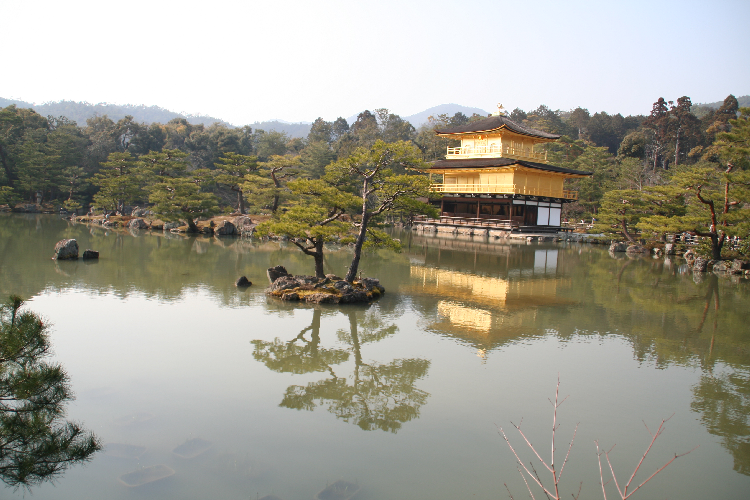
Actually this post is not about Golden Pond, but a Golden Palace on a pond or be it, a small lake. But one has to name something, something and it seemed like a good idea at the time.
I must digress here to state what may or may not be obvious. These posts from our travels are neither a journal or in day by day, hour by hour chronological order. Part of this is due to my love of words and my tendency to write many of them. I do try to think of others in that I ask myself, what would I want to see or want to learn about while in Japan? I try to keep these posts interesting and informative to the best of my ability.
Another issue is that even in the short time that we have been here, we have done so much; seen so many things. I have taken lots of pictures and when we return, I will just have to decide on what to do with them. Lastly, there is the lack of WIFI in Japan. With iPhones, an iPad and a laptop with us, we certainly have the means to post content and pictures in several ways, but outside of where we are staying, there is no internet access.
Oh, there are, WIFI access points everywhere and most are secured networks which require a password. In order to use one of these you have to pay for them by the day or even the month. In order to do that, you need to be living here basically, as the Japanese are not too particularly fond of sharing their WIFI or broadband internet with foreigners. Many Japanese have WIFI at home for their devices. Their smartphones are tied to a prepaid (monthly) satellite service so that they can use their phones, pads, and devices pretty much wherever they are. I have seen several people on trains here, communicating over the internet through social media like Facebook. But, alas for us, we have to wait until we get back to where we are staying to access the internet and use services that require WIFI. I do not know what it will be like in Australia, but we are soon to find out.
But as you walk in Kyoto, soon you find yourself within the woods and then suddenly in the distance, you see this beautiful and phenomenal sight with a background of nature like a picture frame as if made to feature it. Here is the Golden Palace, actually overlaid with 24k gold.
The Golden Palace
I’m not sure why the bottom first section is not gold, perhaps so that no one could scrape it from the structure?
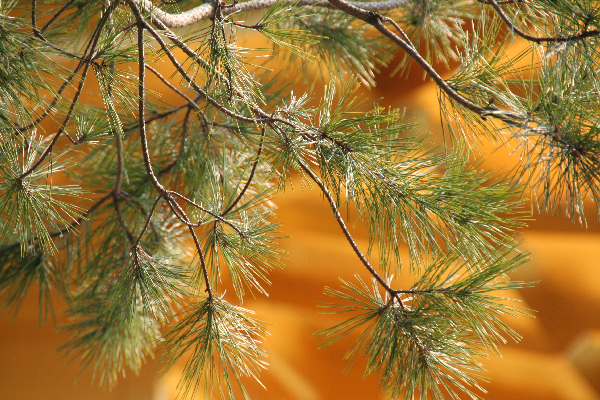
It is beautiful, but I am more awestruck at how it blends in with nature and the angles and the way in which such structures are built.
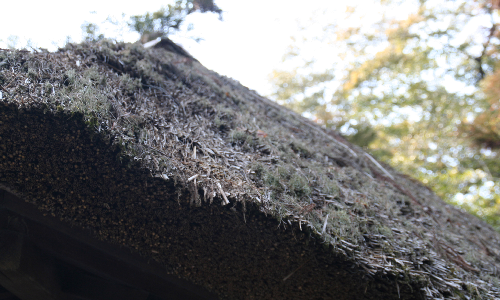
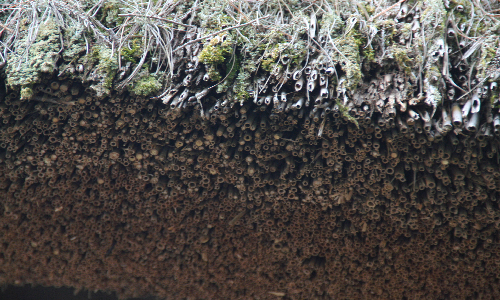
The harmony of nature and the work wrought of humansRoof constructionNatural reed roof
The material again is from nature and the construction by human binds hollow reed so tightly, it insulates and protects against insects, wind, snow and rain while keeping the structure warm in the colder months and cool in the warmer months.
Yes, it is the harmony of nature’s art and the art of humans which make so many things so beautiful in Japan! Though to build such a structure which still stands after so many centuries was long and difficult, naming things in Japan is often short and simple! These are contrasts or more like understatements, figures of speech that call our attention.
A golden palace on a pond is, what this is, but the words cannot describe its effects and affects upon the senses when they are first experienced and long remembered! The words are almost like a haiku poem of just three lines and 17 syllables, but hold great depth of meaning and purpose. But stated so simply and so matter-of-fact, they seem not able to convey the difficulty to master the art form and construct them like, the golden palace. It is just there as if it is supposed to be and always was, waiting only on you and I to discover its truths.
Oh sure, this place is a tourist attraction and many people come here to see it, both foreigners and the Japanese. And why not, wouldn’t you want to see a palace of gold on a pond, we did! So, perhaps this was an intention of its builders that even after the deaths of those it was built for, people would continue to be drawn here; support it and etc. But it’s importance is so much more to the Japanese and to me! It is an example of the art and harmony of, nature and humans simply drawing others to it as if calling out and stating simply; beautifully; poetically, here is…
…The Golden Palace on the Pond
I will close this post with another example of this understating and harmonious blending of the art of nature and humans.
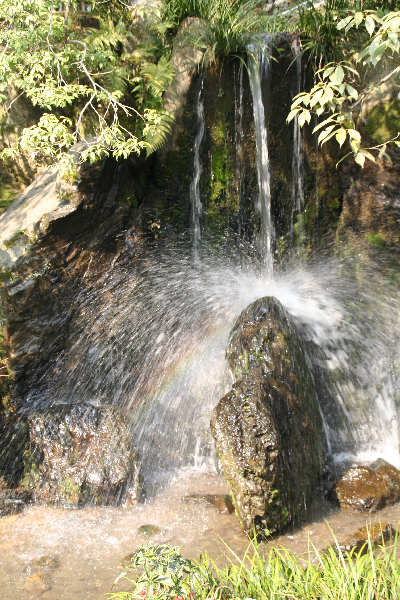
Leaping Fish Fountain
This fountain is also part of the compound of the Golden Palace. The up righted or vertical stone looks like a fish that is leaping up the fountain. Notice the rainbow! 🙂
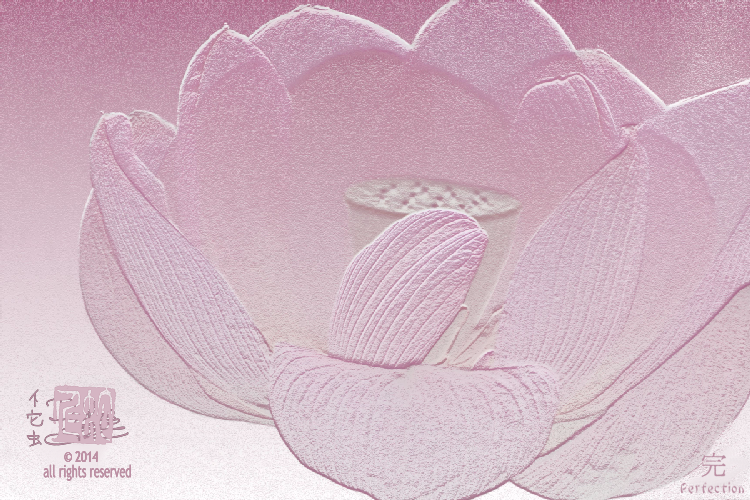
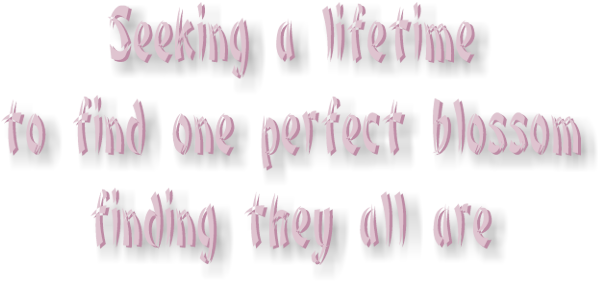
The Lotus is seen throughout Japan and is very significant to their way of life and their beliefs. They are beautiful. I hope you enjoy my art made from a photograph I took in Japan and my haiku poem to follow.
Now the words in the title of this might sound like the Japanese word-sounds for sneezing, they are not, but they are words used in Japan.
Haiku is a three line, 17 syllable poem (in English anyway). It usually is about nature and the form has 5 syllables on the first line, 7 on the second and 5 on the third.
Kanji is a pictorial text originating in China where the characters/symbols have sounds. One definition of the word kanji is “listen.”
There are three basic components in the Japanese language: hiragana, katakana and kanji. Whereas the picture of kanji is used to pronounce the sounds, katakana is most often used to pronounce native words, where there is no kanji. Hiragana is often used in transcribing foreign words, for example:
ホットコーヒー
Hottokōhī
“hot coffee” in Japanese
It sounds very similar to “hot coffee” and trust me, it is something that I have used in the past and will use again shortly. 🙂
Speaking of coffee, did you know my favorite coffee is Jamaican Blue Mountain and that Japan has imported nearly 90% of all the Blue Mountain coffee and have for many years? True enough!
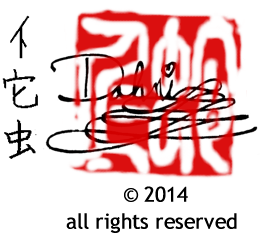
Many people use their own personal kanji for purposes of identification. Artists often use a more stylized kanji to sign their work by hand lettering or with a Chinese red stamp, along with their signed katakana or kanji in black, usually vertical and to the left or right of the kanji, but sometimes on top.
My kanji
I very much wanted my own kanji and because I met the criteria, I was able to get mine.
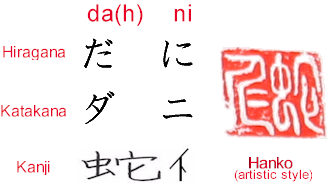
Kanji is unique as the pronunciation of my kanji in Japanese is actually dah + knee. The characters (dah + knee) are the Japanese symbols da(h) + ni and are the sounds for either a coiled snake ready to strike or a samurai with blade, ready to strike or as a man (warrior) of action. Both examples are interpreted as being purposefully restrained by choice, which connotes, ‘wisdom.’
One of the signs of the Japanese zodiac is a snake. This corresponds to our zodiac as November/December or the sign of Sagittarius the archer. I was born in 1953, which was also, the year of the snake according to the Japanese zodiac. Since I was born in a year of the snake, in the month of December (under the sign of the snake) and my name combines the Japanese kanji(s) da + ni (pronounced dah + knee), I have a legitimate right to this kanji. Some people just call me, ‘snake man.’ 🙂
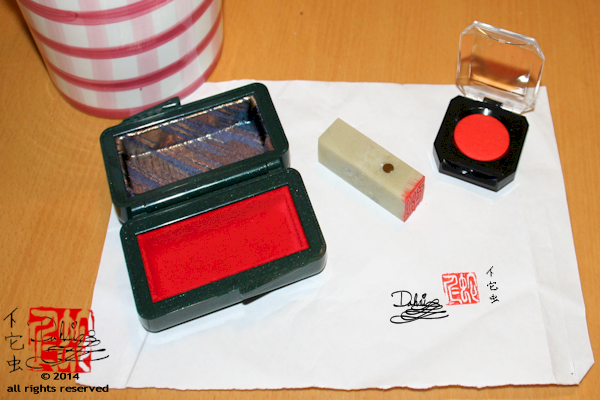
The kanji is as unique as a fingerprint (no two are alike) and can be used as legal identification in Japan. I’ve seen many people at banks in Japan, pull out their kanji kits (ink pad and kanji) and stamp important papers, cash checks and etc., just like we use our signatures in the United States. My interest in having my own kanji was purely artistic. But wanting a kanji and even having the right to one is not enough! It must be thoroughly researched and determined that it has never been used before. Specialists in this field pore over many books to assure this, before granting their authority and recording the kanji in a book. The last stage is, to make the actual kanji into something that can be used and duplicated by its owner. This is performed by an authorizedhanko maker.
Hanko (seal) is typically a stone with the kanji cut into it so that when it is stamped in ink, it leaves the impression of the kanji. The hanko maker hand cuts the design into stone or other material. In Japan, seals in general are referred to as inkan 印鑑 or hanko 判子[4]. Inkan is the most comprehensive term; hanko tends to refer to seals used in less important documents.
A hanko, like a fingerprint, is one of a kind. The styles are either round or square as shown. The Kanji can either be actual or more stylized as shown in my design. The latter is preferred by most Asian artists. To the side of the design, the characters are usually hand signed with black ink and are the actual characters of the Japanese type script known as Katakana or kanji. The Katakana is the same as the Kanji in meaning and pronunciation as in mine, dah + knee.
da(h) ni – Hiragana, katakana and Kanji
Yes, I am proud of my kanji, but I am not boasting. I thought perhaps you might find this whole thing interesting as do I?
I sometimes use my kanji on my original artwork and photographs. And I do one more thing. I place my actual signature within my kanji and it all becomes part of the design.
For our: Dear friend Janet and our Dear niece Jenny
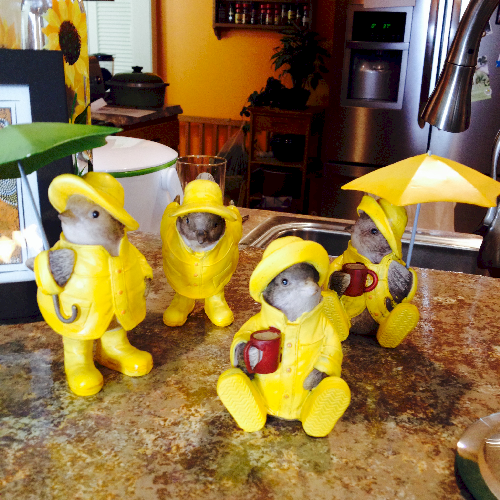
The Little Jenny Wrens Family
I am not exactly sure if I got the four little Jenny Wrens, pictured above, for my wife Susan on Valentine’s Day or for me? 🙂
But I thought they were so cute. There are four different little Jenny Wrens pictured in four different poses. I did not have the heart to break up the little family, so I brought them all home to live with us! Think Spring everyone! 🙂
Jenny Wren – is an expression that our friend Janet had not heard of before. So this post in part is, for you Janet. 🙂
Jenny – is the first name of my brother’s oldest daughter, our niece. So this post is also, for you Jenny. 🙂
Jenny Wren – was the name our Mom called this little common wren with the uncommon song.
Jenny Wren – Is a light brown colored, but somewhat washed–out looking little bird that is attracted to the bushy tangles of the garden. Except for off–white undersides, which cannot be described as bright even on the sunniest of days, the House Wren is decidedly a very nondescript looking bird. But what the “Jenny” wren, as my Mom used to call her, lacks in visual attraction, she most assuredly makes up for in song. She is one of the earliest arriving spring songsters. You will know Spring has arrived when little Jenny Wren is back home by singing her sweet song loud and clear. She bubbles and warbles soft and low and works up just like a tea pot on the stove. Little Jenny Wren boils over in song.
Jenny Wren – A beloved character, in a Charles Dickens’s novel. She’s the little disabled doll’s dressmaker who brightens the pages of ‘Our Mutual Friend,’ Dickens’s last completed novel, in 1864.
Jenny Wren – A little bird (a wren) in the 1919 children’s book by Thornton Waldo Burgess (January 14, 1874 – June 5, 1965). Burgess was a conservationist and author of children’s stories. He loved the beauty of nature and its living creatures so much that he wrote about them for 50 years in books and his newspaper column, “Bedtime Stories”. He was sometimes known as the Bedtime Story-Man. By the time he retired, he had written over 170 books and 15,000 stories for the daily newspaper column.
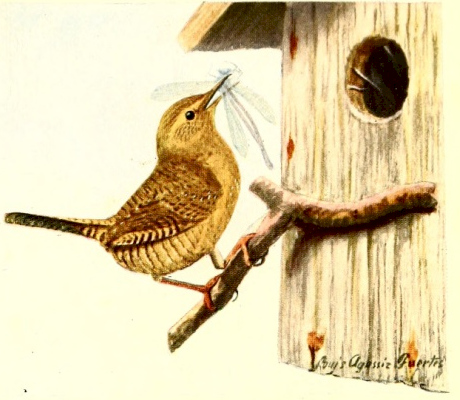
Little Jenny Wren
“Jenny Wren, the little saucy wren that builds near your home.”
from the book: ‘The Burgess Bird Book for Children’ by Thornton Waldo Burgess
illustrations by Louis Agassiz Fuertes
Listen to her sing!
Jenny Wren – A song by Sir Paul McCartney, ‘Jenny Wren,’ in 2005
Jenny Wren
“Like so many girls, Jenny Wren could sing
But a broken heart, took her song away
Like the other girls, Jenny Wren took wing
She could see the world, and its foolish ways
How, we, spend our days, casting, love aside
Losing, sight of life, day, by, day
She saw poverty, breaking up her home
Wounded warriors, took her song away
But the day will come, Jenny Wren will sing
When this broken world, mends its foolish ways
Then we, spend our days, catching up on life
All because of you, Jenny Wren
You saw who we are, Jenny Wren”
Note: The solo is played on an Armenian woodwind instrument, called duduk (pronounced due -duke) and is a first in pop music history. It is played by Venezuelan born, world winds specialist & multi-instrumentalist Pedro Eustache. Susan and I had the privilege of hearing and seeing Pedro perform live at a Yanni concert. He is an incredible and a versatile musician. The duduk is an ancient instrument with hauntingly beautiful sounds.



 Robin Song on YouTube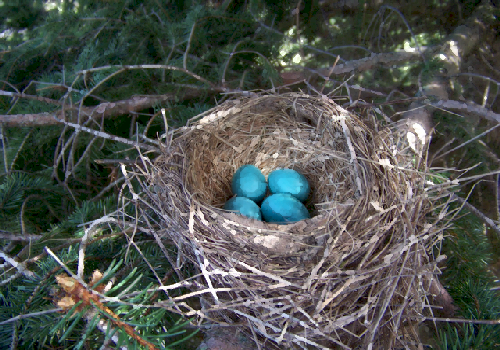











 gatheringplace.blog