
Short url to this post: https://wp.me/p4jGvr-1eT
By Dahni
©️ 2026, all rights reserved
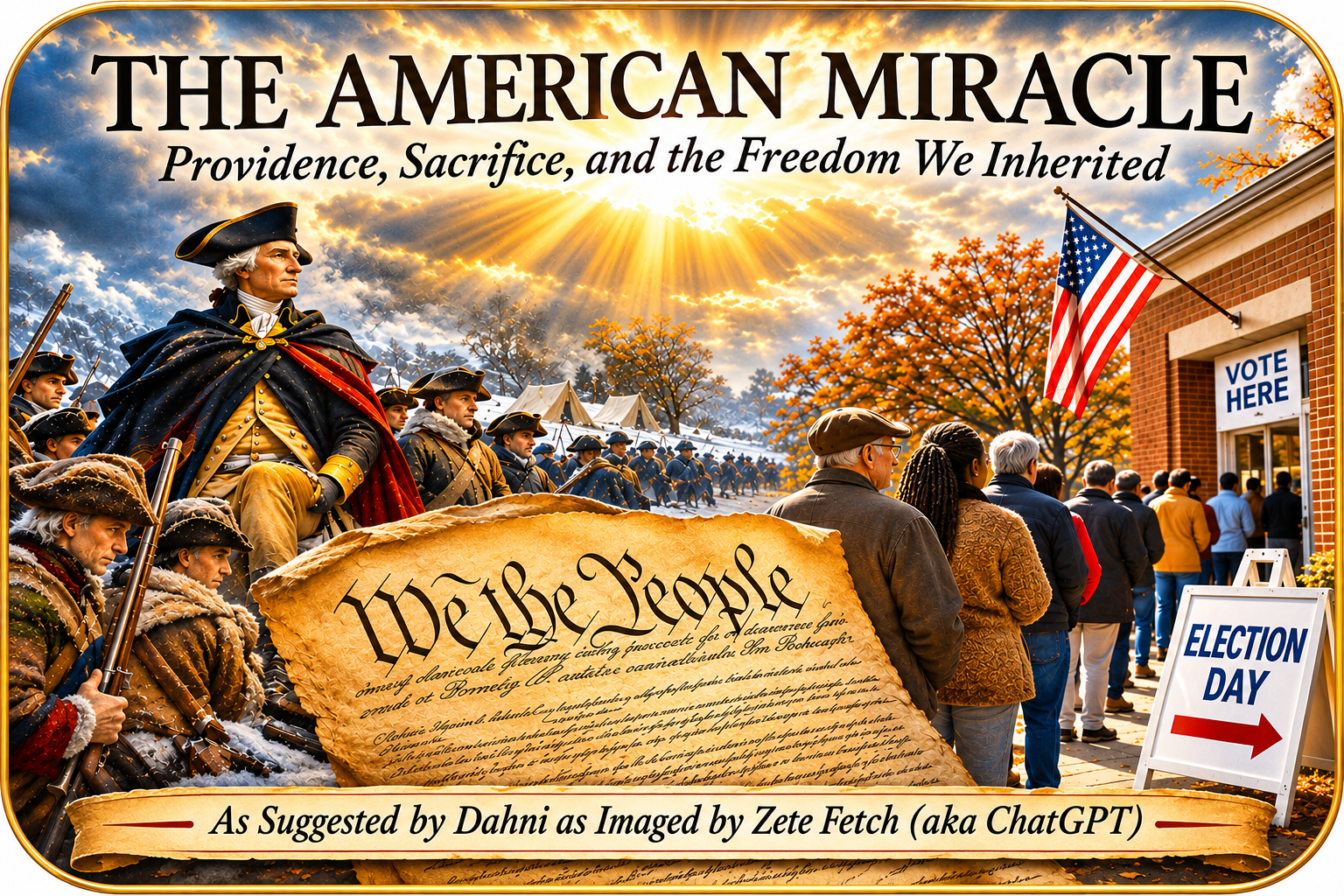
THE AMERICAN MIRACLE
Providence, Sacrifice, and the Freedom We Inherited
Election Day — November 3, 2026
What Is Providence?
Providence is the foreknowledge, wisdom, care, and sovereign guidance of God in the affairs of His creation, including the lives of individuals and the course of nations.
Divine providence is the belief that God is neither absent from His creation nor indifferent to what happens within it. His purposes may be accomplished through people, circumstances, decisions, and events—even when those involved cannot see the larger picture.
Providence does not eliminate human responsibility, nor does it mean that every human decision is God’s will. It recognizes that God’s purposes can operate within history without removing mankind’s freedom to choose.
And that brings us to the founding of the United States of America.
When a People Forget Their History
The film The American Miracle: Our Nation Is No Accident opens with a sobering observation:
“When a people do not know the history of their nation, they can quickly lose the freedoms that millions have fought and died for.”
— Attributed in promotional material to Colonel James Gallagher, USAF (Retired), Revolutionary Founding Era Historian.
The film uses the wording “does not know.” The quotation’s original authorship has not been independently established.
Nevertheless, its warning is worth considering.
Today is Election Day.
Millions of Americans will exercise a right that did not come cheaply. It was secured through courage, sacrifice, suffering, and the determination of men and women who believed liberty was worth defending.
When the signers of the Declaration of Independence pledged their “Lives, our Fortunes and our sacred Honor,” they understood the consequences of their actions.
But was America’s independence accomplished by human determination alone?
I recently watched The American Miracle. The film presented several accounts from our nation’s founding that I had never heard before.
They left me considering a question.
Was the founding of the United States merely a remarkable sequence of historical events, or was there something more—divine Providence?
George Washington — A Remarkable Survival
On July 9, 1755, during the French and Indian War, a young George Washington served under British General Edward Braddock at the Battle of the Monongahela.
The British forces suffered a devastating defeat. Soldiers were killed and wounded all around Washington.
Yet he survived.
Nine days later, Washington wrote to his brother that four bullets had passed through his coat and two horses had been shot beneath him.
Despite the destruction surrounding him, he escaped without injury.
Washington himself explained his survival in these words:
“But, by the All-powerful Dispensations of Providence, I have been protected beyond all human probability or expectation.”
This is not a statement invented by a filmmaker. It comes from Washington’s own letter dated July 18, 1755.
There is another extraordinary account associated with this battle.
According to a story preserved in later historical writings, a Native American chief told Washington that he had ordered his warriors to kill him. Despite repeated attempts, they could not bring him down.
The chief reportedly concluded that Washington was protected by the Great Spirit and could not be killed in battle.
The story, sometimes called The Indian Prophecy, was published in later accounts, including one by Washington’s step-grandson, George Washington Parke Custis, in 1826.
The chief’s reported words and the meeting itself cannot be independently verified.
But Washington’s survival, the bullets through his coat, the horses shot beneath him, and his acknowledgment of Providence are documented.
Washington believed that God had preserved his life.
Princeton — January 3, 1777
More than twenty years later, Washington again faced what appeared to be almost certain death.
During the Battle of Princeton, British forces had driven back American soldiers. General Hugh Mercer was mortally wounded, and the American lines were beginning to collapse.
Washington rode forward on horseback to rally his retreating men.
Historical accounts describe him riding between the British and American forces, exposing himself to enemy fire.
He encouraged his soldiers to stand and fight, then led them toward the British lines.
Musket fire erupted.
Men fell.
According to a later account, Washington’s aide, Colonel John Fitzgerald, covered his eyes, believing he was about to witness the general’s death.
When the smoke cleared, Washington remained on horseback.
Uninjured.
The Americans rallied and won the battle.
Washington’s leadership and exposure to danger at Princeton are historically documented, although some of the more dramatic details come from later retellings.
Consider these two battles.
In 1755, bullets pierced his clothing and horses were shot beneath him.
In 1777, he rode into the deadly fire of opposing forces and survived.
Coincidence? Extraordinary good fortune? Or Providence?
The Hillbillies Who Helped Save the Revolution
There is another extraordinary event that I found missing from the film.
On October 7, 1780, a group of backcountry frontiersmen, many from settlements beyond the Appalachian Mountains, confronted British Major Patrick Ferguson and his Loyalist forces at Kings Mountain, South Carolina.
These men became known as the Overmountain Men.
They were not the polished professional soldiers of a great European army. They were farmers, hunters, woodsmen, and frontier militia—men who knew the mountains and how to fight in them.
One might even call them the hillbillies who helped save the Revolution.
At Kings Mountain, Patriot militia surrounded Ferguson’s position and defeated his force of approximately one thousand men.
Ferguson was killed. His Loyalist command was effectively destroyed.
The troops defeated at Kings Mountain were predominantly American Loyalists fighting for the British Crown, rather than British regulars. Nevertheless, their defeat was a severe blow to General Cornwallis’s Southern Campaign.
The British advance into North Carolina was disrupted.
Then came the Battle of Cowpens on January 17, 1781, where Daniel Morgan’s American forces defeated Lieutenant Colonel Banastre Tarleton’s command.
Then Guilford Courthouse on March 15, 1781, where Cornwallis won the battlefield but suffered heavy casualties.
The British Southern Campaign was being worn down.
And on October 19, 1781, just one year and twelve days after Kings Mountain, Cornwallis surrendered at Yorktown.
Yorktown was made possible by several converging events: American victories and resistance in the South, Washington’s leadership, the assistance of French troops, and the French fleet’s control of the Chesapeake.
Kings Mountain alone did not win the Revolution.
But those determined frontiersmen helped set in motion a chain of events that contributed to Cornwallis’s eventual defeat.
History is often changed by a determined minority, not an enthusiastic majority.
And sometimes those who change history are people whom history nearly forgets.
Franklin’s Appeal to Providence
On June 28, 1787, during the Constitutional Convention, Benjamin Franklin addressed delegates who were struggling to agree upon the framework of the new government.
Franklin reminded them of the prayers offered during the Revolution and the help they believed they had received.
He asked:
“And have we now forgotten that powerful friend? or do we imagine that we no longer need his assistance?”
He then proposed that prayers imploring Heaven’s assistance be held each morning before the Convention began its business.
The proposal was not adopted. The Convention adjourned without voting upon it.
But Franklin’s words, preserved in James Madison’s notes, reveal something important.
At least some of the founders believed that the nation’s survival and future required more than human wisdom.
They believed they needed God’s help.
The Miracle Did Not End in 1787
Near the conclusion of The American Miracle, actor Richard Dreyfuss delivers a sobering warning about the future of our nation.
I understood his warning. I even agreed with the seriousness of it.
But something troubled me.
The entire film had presented the extraordinary events surrounding America’s founding under one word:
MIRACLE!
And I found myself asking:
If God intervened then, has He stopped intervening now?
Has the God who preserved Washington, who heard the prayers of the founders, and who was acknowledged in the struggles for independence somehow withdrawn from the affairs of this nation?
I do not believe so.
The Scriptures have not changed.
“For God so loved the world, that he gave his only begotten Son, that whosoever believeth in him should not perish, but have everlasting life.”
John 3:16 King James Version of 1611
“The Lord is not slack concerning his promise, as some men count slackness; but is longsuffering to us-ward, not willing that any should perish, but that all should come to repentance.”
2 Peter 3:9
“Blessed is the nation whose God is the LORD; and the people whom he hath chosen for his own inheritance.”
Psalm 33:12
“The effectual fervent prayer of a righteous man availeth much.”
James 5:16
And Jesus declared in Matthew 5:18 that not one jot or tittle would pass from the law until all was fulfilled.
These are not merely comforting words from a distant past.
They remain true.
God is still here.
He still loves the world.
He is still not willing that any should perish.
He still hears the prayers of the righteous.
And there are still those who believe Him and pray.
I am one of them.
Election Day — Our Responsibility and His Providence
Today, many other Americans will cast their votes as I will. I tried to go at 7:15 AM this morning. It was cool 56°F, breezy and overcast. People were already in a long line outside of our polling place. It was more than just people voting on their way to vote. I am proud of them—of us—We the People
We should remember that the liberties we exercise were not simply handed to us.
Men and women suffered and died for them.
The founders pledged their lives, fortunes, and sacred honor.
Washington risked his life on the battlefield.
Frontiersmen crossed mountains to confront an enemy.
Soldiers endured hunger, cold, disease, and death.
France provided indispensable military assistance.
There were many other extraordinary things such as the use of longer rifles. to fire further and more accurately. Not standing toe-to-toe with the British but firing from behind rocks, firing upon officers first, and using guerrilla warfare (as Francis Marion – ‘The Swamp Fox’ and others). Couriers and express riders, (postal and messaging services like Paul Revere’s famous ride). There was an entire spy network with men, women and children, invisible ink and secret codes. From the story told to Washington from a man that heard of another story from a slave, Washington, having previously survived smallpox and acquired immunity, (though he suffered from its effect for the rest of his life), ordered mass inoculation his remaining troops with live “pox”. He improved sanitation and health by ordering the latrines moved away from their food source.
The American Revolution was fought not only against British soldiers, but also against disease. Smallpox threatened to destroy the Continental Army from within, and George Washington understood that an epidemic could accomplish what British weapons had not.
But the knowledge that helped protect his soldiers had a history extending far beyond the American colonies.
In Africa, smallpox inoculation was already being practiced before it became accepted in colonial America. An enslaved African named Onesimus explained the procedure to the Boston minister Cotton Mather, describing how introducing material from a smallpox infection into a healthy person could produce a milder illness and protection against future infection.
In a letter dated July 12, 1716, Mather reported that Onesimus had described the practice as common among a people he called the “Guramantese.” This name has been associated by some historians with the Garamantes, an ancient Saharan civilization centered in what is now Libya. The Garamantes had maintained trading relationships with the Roman world centuries earlier. Other historians identify Mather’s term with the Coromantee peoples of West Africa. The exact geographical connection remains disputed, but the African origin of Onesimus’s knowledge is documented.
In 1721, during a smallpox epidemic in Boston, physician Zabdiel Boylston began inoculating patients with Cotton Mather’s encouragement. The procedure was controversial and fiercely opposed by many, but it was not a general government mandate.
More than half a century later, on February 6, 1777, Washington ordered the inoculation of Continental troops against smallpox. In his letter to Dr. William Shippen Jr., he explained that an uncontrolled epidemic posed a greater danger to his army than the enemy’s weapons.
Unlike the Boston inoculations of 1721, Washington’s program was a military mandate. It became one of the most consequential medical decisions of the Revolutionary War.
Consider the extraordinary connection: medical knowledge carried from Africa by an enslaved man helped introduce colonial Americans to a practice that Washington would later employ on a massive scale to preserve the army fighting for American independence.
Providence? Human ingenuity? Knowledge passed from one generation to another? Perhaps this history invites us to consider all three.
The British captured Philadelphia in 1777 under General William Howe. Cornwallis participated in that campaign, but was not its overall commander. Washington and his troops marched and many had rags on their feet. Most were ill-equipped and ill-trained. Something greater than their lack of pay, health and food– kept them going during the time known as the Winter in Valley Forge. But when Cornwallis surrendered at Yorktown, he could not believe these were many of the same soldiers he had previously fought.
If it were not for arrogance or some other higher reasoning (Providence), all that was needed was to follow the blood trails through the snow toward Valley Forge, and the Revolutionary War would likely have ended then.
The American forces needed every possible advantage against Britain’s formidable military and naval power, believed to have been the greatest in the world at that time. Many times the American were facing vastly superior odds.
And through it all, many of those who participated believed they were witnessing the hand of Providence.
Historical research can document the events and the beliefs of those who experienced them. Whether those events were acts of divine intervention is ultimately a question of what you and I believe.
But the historical evidence of their sacrifices is undeniable. In other words, these things DID happen.
Our responsibility today is not to take those sacrifices or the freedoms they helped secure for granted.
Nor should we imagine that voting, government, political parties, or human wisdom alone can guarantee the future of this republic.
The same God whom Washington acknowledged as Providence is not confined to the eighteenth century.
The same God Franklin appealed to has not ceased to hear prayer.
And the same God who so loved the world has not ceased loving it.
I cannot promise what the outcome of any election will be, or what tomorrow will bring for this nation.
But I know where I place my trust.
The American Miracle was not merely about the men and women and children who founded a nation. It was also about the Providence they believed had guided them.
And on this Election Day, I believe that Providence remains as relevant as ever.
Richard Dreyfuss — A Warning for America
Near the end of The American Miracle, Richard Dreyfuss expresses his personal attachment to America:
“America is something that I– I hold in my heart, and I am not sorry about it.”
He then argues that Americans have lost trust in their institutions, including the press, the judiciary, education, and politics.
He challenges his audience:
“Now, did I just say anything that you would argue with?”
And he warns:
“If we don’t get that back, this country will not be anything like America.”
— Richard Dreyfuss, The American Miracle: Our Nation Is No Accident (2025 film; quotations transcribed from the film).
His warning deserves consideration.
A nation that loses confidence in its institutions, abandons its founding principles, or forgets the sacrifices that secured its liberties faces a very uncertain future.
But is the future of America dependent entirely upon the ability of Americans to restore what has been lost?
What about Providence?
If the central argument of this film is that God intervened in the founding of America, should we conclude that He no longer intervenes in its affairs?
I cannot.
The founders are gone.
The battles have ended.
The Constitution remains.
The responsibility for preserving liberty has passed to succeeding generations.
But God is still here.
He is still my God.
I am still here.
And I still pray.
Thomas Jefferson — The Constitution
While serving as America’s minister to France, Thomas Jefferson followed the development and ratification of the Constitution through correspondence.
Writing to David Humphreys from Paris on March 18, 1789, Jefferson observed that the American example of changing a constitution through deliberation rather than armies would be of immense value to the world.
He then declared:
“The constitution, too, which was the result of our deliberation, is unquestionably the wisest ever yet presented to men.”
— Thomas Jefferson, letter to David Humphreys, March 18, 1789.
Jefferson did not consider the Constitution perfect. He had argued for the addition of a Bill of Rights. Nevertheless, his words expressed extraordinary admiration for what had been accomplished.
In a letter to his nephew Peter Carr, dated August 10, 1787, Thomas Jefferson wrote:
“Question with boldness even the existence of a God; because, if there be one, he must more approve of the homage of reason, than that of blindfolded fear.”
— Thomas Jefferson, August 10, 1787
George Washington — The Invisible Hand of Providence
And perhaps no words bring these historical events and the central message of The American Miracle together more fittingly than those spoken by George Washington in his first inaugural address on April 30, 1789:
“No people can be bound to acknowledge and adore the invisible Hand which conducts the affairs of men more than those of the United States.”
George Washington first inaugural address April 30, 1789
Historical references
George Washington, letter to John Augustine Washington, July 18, 1755.
George Washington Parke Custis, Recollections and Private Memoirs of Washington, nineteenth-century accounts.
Battle of Princeton, January 3, 1777 — contemporary and later military accounts.
National Park Service, Kings Mountain National Military Park — Battle of Kings Mountain, October 7, 1780.
Battles of Cowpens and Guilford Courthouse, 1781 — National Park Service and American Battlefield Trust histories.
Yorktown Campaign and surrender, October 19, 1781.
James Madison, Notes of Debates in the Federal Convention of 1787, June 28, 1787.
Thomas Jefferson, letter to Peter Carr, August 10, 1787.
The Declaration of Independence, July 4, 1776.
The American Miracle: Our Nation Is No Accident — opening quotation, provisionally attributed to Colonel James Gallagher, USAF (Retired).
-Dahni

