Guhday mates from Donnie, Your Aussie Koala ginger & lavender lover (liker)
First of all, you need to know that I know that Susan is and always will be my first and number one LOVE! She knows this and she knows that I know this is true! But there is room in all of our lives for many loves. Thank God this is true, because I now have some new loves!
Yeh, yeh, technically, we are supposed to like stuff or things, but love people. OK then, I have some new stuff thingies that I really, really way really to infinity and beyond really and truly LIKE a HEAPING HELPING OF A WHOLE LOT OK?!!!! 🙂
It all starts with lovely ginger. Delicious, spicy and all, but it has a lot of other uses and benefits.
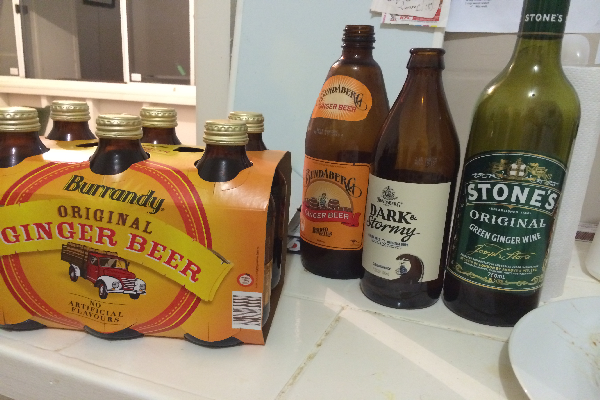
Ginger Beer, Ginger Ade (not shown), Dark & Stormy (Ginger beer, lime and rum) and Ginger Wine
All of these above are delicious and very beneficial as an aide to digestion, upset stomach, motion sickness and other uses. Australia is full of all kinds of ginger beverages. But to follow is my latest discovery. I don’t much care for the taste of champagne. I never have, until NOW!
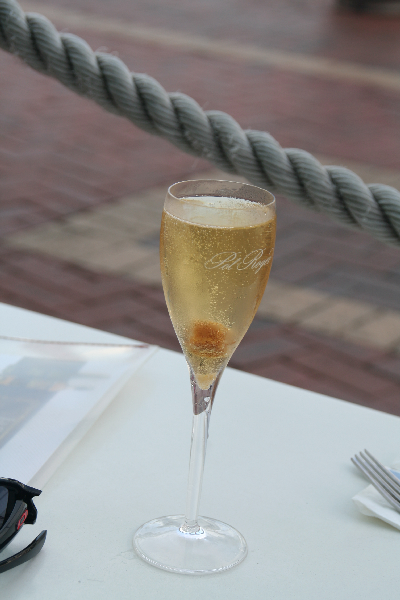
Champagne with a ginger sugar cube
OMG, this is absolutely incredible. I’ve have been scratching my head and have come up with my own recipe for making beautiful ginger sugar cubes to add to some champagne. I can’t wait to try this for you when we get home!
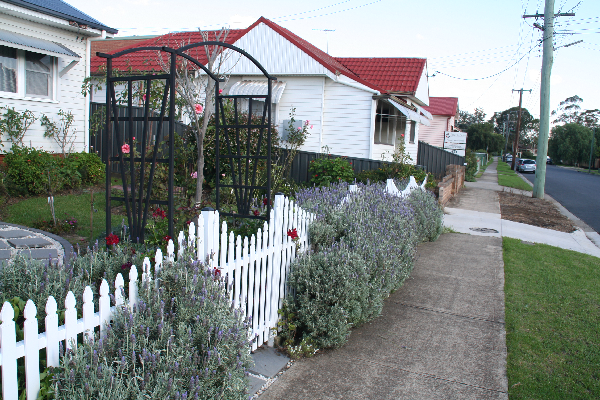
Now we move on to Lavender. I love it’s fragrance and calming effect. Lavender grows all around us here in Australia. I love to take a walk and throughly and thoroughly enjoy their nasal delights that are especially fragrant in the air after a rain. But as they say in Australia, “No Worries,” you can always grab a leaf or so and crush it and roll the oil around on your hand and you have instant hand-fresh. Lavender is great for soap and as an air-freshener. But if it is food grade, it is a delicious flavor to add to salads, breads and deserts.
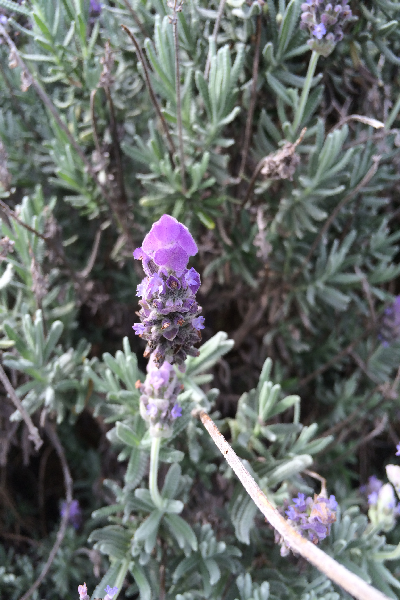
Lavender along the fence line
The flowers are beautiful too!
Lavender Flower
Ever since we were in Japan and I had several cones of Green Tea ice cream, I have been thinking of a way to make it at home with coconut milk to make it more delicious/nutritious with less calories. Now, I am not only excited to begin work on this when we return to the states, but why not Lavender Ice Cream out of coconut milk too?!
Ginger and Lavender can be found in the United States, so why am I so inspired to work with these while here in Australia? For one thing, there is so much of both all around us here. And finally because, it is Australia that has inspired me! Thank You Australia! I’ll send you my recipes when they are to my liking. 🙂
Guhday mates from Donnie, Your Aussie Koala eucalyptus tree specialist
I could have just as easily called this post, On: Gum Trees because, it is. And a Gum Tree is certainly easier to say than perhaps, an Eucalyptus Tree and I suppose it is, even though gum trees and eucalyptus trees are related and not to mention our cousin myrtle.
Let me see if I have this straight. Not every gum tree is an eucalyptus tree, but every eucalyptus tree is a gum tree? Huh? What? These trees are called gum trees and are classified as trees and shrubs which have smooth bark which exudes a lot of sap from any break in the bark. Hence, sap, sappy, gummy or gum.
As a Koala Bear, surely you would think that I am quite particularly partial to eucalyptus trees and especially since I dine on their delicious leaves! 🙂 But I am not the only one in Australia that loves the“eucalypts” (as they are often called here down under) and not everyone loves them like I do!
The kookaburra sometimes sings from a Coolabah (a type of eucalypt), waltzing Maltilda often rests against one as does her swagman, just to mention a few. For more information about these names, terms and characters on this blog, see Waltzing Maltida, Damper and the Kookaburra song from Music Down Under.
By the way, the Coolabah is also the name of a certain style of a special Australian hat made by Akubra. I am hoping and waiting for a email that my size and color has bee found. I am anticipating a simple reference that reads: Found Hat – Bring Head! 🙂 If you are an Aussie reading this and you can help me locate one in black size 57 I will love you forever! 🙂
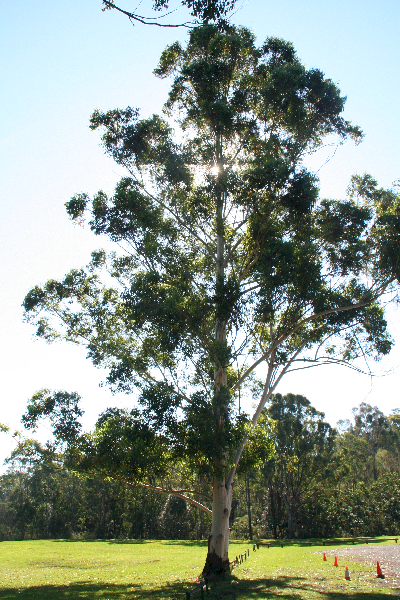
Long Straight and Tall
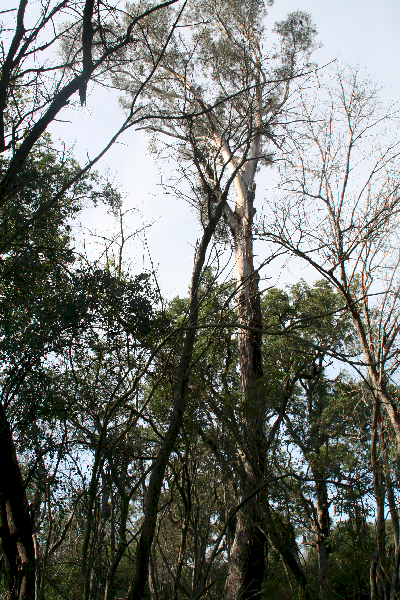
With the eucalyptus/gum/coolabah species of trees having so many varieties, it’s obvious that there are many of them in the country of Australia. Many of them grow really tall and grow mostly straight. They are excellent for timber and for telephone/utility poles. I have seen several in our neighborhood where one seems to be its natural color, another tinted green as a preservative I assume and another with saw cut beveled edges. Perhaps the differences may be understood by the dates when they were installed and methods that have evolved through the years
These are remarkable trees with little that bother them, but there are a few exceptions. There is one insect, Psyllids that leave behind sugary secretions on the underside of the leaves they ingest. These sugary secretions are called Bell Lerps and attract some ants and the beautiful sounding birds called the, Bell Birds. Yes, this is exactly what they sound like! For more information see on this blog: Bell Birds
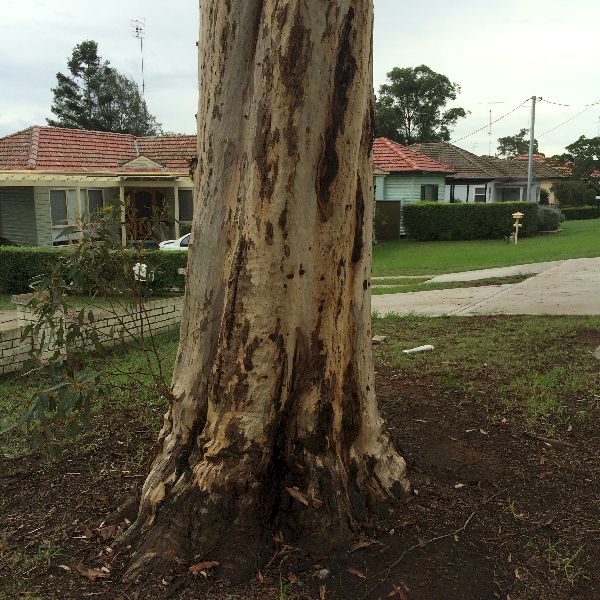
Closeup of a seemingly naked tree
There is a very rare type of eucalyptus known as the White Gum which is nearly extinct, but it is seen in and around Camden, New South Wales, Australia.
Many of these eucalyptus trees shed their bark annually. And here in Australia, the bark is just simply called, ‘fuel.’ The trees might look like they’re naked, but the bark will grow back.
In addition to the bark falling off in either strips or chucks (depending on the variety) sometimes, entire branches will fall off. The Aussies know this, but for us foreigners that do not, signs are sometimes placed near some of these trees, especially in the Australian summer (December to February) to alert and protect others from unexpected and sudden branches falling. These fallen branches are actually hollowed out from within by termites and yet the tree still survives.
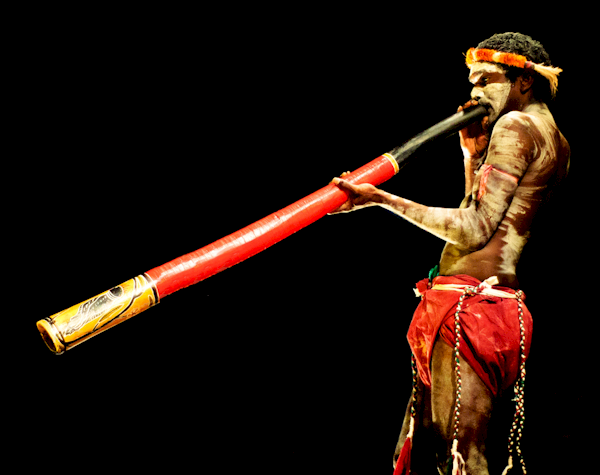
The Aborigines, walking in the forest would tap on the appropriate size of fallen branches they were seeking, to determine the quality of sound it made. Some of these chosen fallen and hollow branches are suitable for the famous didgeridoo instruments, used in Australia. They are carved, and decorated by skilled craftsmen and artisans.
The Didgeridoo is quite possibly the oldest instrument in the world – and still one of the best. Forever associated with Aboriginal Music, the sound of Australia is now available everywhere and growing in popularity.
Aboriginal Man Playing a Digeridoo
Modern Music with a Digeridoo, Xavier Rudd – http://www.xavierrudd.com/
It is estimated that there are over 700 varieties of eucalyptus tree with just 15 of these outside of Australia, but of those 15, only nine are not found in Australia. I suppose you could say, we Aussies have cornered the world marketplace on “eucalypts.“
The tree looks dead, but it’s not
Other uses of these amazing trees are: pulp, paper, charcoal, ornamental uses, as an antiseptic, disinfectants, dyes, insect repellents, mosquito repellents, cough drops, deodorizing, decongestants, toothpaste, sweets and bees from their flowers produce delicious honey.
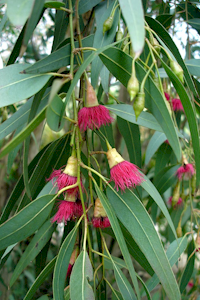
Image from Wikipedia – Eucalyptus leucoxylon var. ‘Rosea’ showing flowers and buds with operculum present
They are fast growing and some trees, even if cut off from the roots, will grow back. Their roots dig deep into the earth and to some people, this water sucking tree is a good thing, as it helps to reduce the spread of malaria from stagnant pools of water the roots will just suck dry. To others, these sponge-like trees steal the water from everything else that needs it.
Due to the depth its roots reach in the earth, they are often called – prospectors, gold prospectors. Yes, you read that correctly, gold! They will actually transfer some all the way into its leaves. These gold-leaf-nugget-clusters may not be worth collecting, but they can sure tell one that this tree, where the gold may be found in its leaves, could be sitting on a fortune below its roots in a huge vein of gold!!!! 🙂
Some believe these trees are not so great as they are a fire hazard. Much of the time, Australia can be quite arid and dry, even though humidity, for example, just yesterday was at 98%. Bush fires have spread and burned perhaps, 1000’s and 1,000’s of acres. And the eucalyptus does not endear itself to many, when it contributes greatly to these consuming fires, since it sheds its bark and drops branches – adding fuel to the fires. But how quickly whole forests grow back and how fertile the soil, after a fire, is amazing. Despite how anyone may feel about these trees (favorably or unfavorably) they have most likely been here a whole lot longer than people have. And the most amazing thing to me about these trees and the purpose of this post is, their ability to adapt.
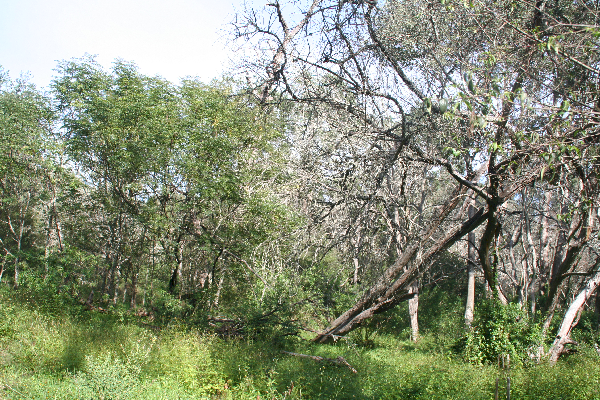
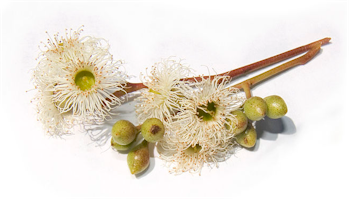
A small local forest as it might have looked a hundred years agoImage from Wikipedia – Eucalyptus melliodora, showing flowers and opercula
To continue life, life most reproduce itself. It is no different for these trees. They grow, flower and are pollinated by bees. They produce fertile seeds and many are as hard as, little green rocks. The trees drop bark which is like surrounding their trunks with kindling to attract fire!
Its bark, sap and leaves are full of volatile chemicals. The Blue Mountains (which we will be visiting this weekend) is so-named because of, a blue-like haze from the tree-leave combustible chemicals in the air. It’s like these trees are waiting for and setting up conditions for a lightening strike to start the fires that will destroy them.
But here is the conclusion of the seemingly purposed set-up of its own destruction and continuation. There are two dominant theories on this. Some believe those hard as rock seeds will not open unless there is a fire. Others believe that they will only open when the soot mixes with water, after a fire Whatever is factually accurate the truth is, these trees continue their species through FIRE and they seem to try and bring the fires!!!!
Seeds will only open to either fire or soot mixed with water
Being in Australia, I thought I should share some music. What better songs than ‘Down Under’ by the 80’s Australian band, Men at Work and a childhood favorite, The Kookaburra Song by Marion Sinclair in 1932.
“Marion Sinclair wrote the song in 1932 for a contest being held by the Victorian Girl Guides.
The competition was for an ‘Australian round’ song. Her song, the Kookaburra Song won and was introduced by Marion at the World Jamboree in Frankston, Victoria in 1934. It was instantly a hit with the girls and has become a much loved song all over the world.
This is a fun children’s song. A gum tree is a name for the eucalyptus tree. There are more gum trees than any other kind of tree in Australia.
Lawsuit The Kookaburra song was involved in a copyright dispute with the Aussie band Men at Work over their song (I come from the land)”
The Song, ‘Come from the Land’ or simply ‘Down Under’ had a flute riff which the Australian Court ruled is an infringement of the copyrighted tune, ‘The Kookaburra Song.’ Despite the controversy between the two songs, and even former members of ‘Men at Work,’ both songs are wonderful and are shared here via YouTube videos. But first, what does a Kookaburra look and sound like?
Now for the lyrics and followed by the video of, ‘Down Under.’
Travelling in a fried-out Kombi
On a hippie trail, head full of zombie
I met a strange lady, she made me nervous
She took me in and gave me breakfast
And she said:
“Do you come from a land down under
Where women glow and men plunder
Can’t you hear, can’t you hear the thunder
You better run, you better take cover.”
Buying bread from a man in Brussels
He was six foot four and full of muscle
I said, “Do you speak-a my language?”
He just smiled and gave me a Vegemite sandwich
And he said:
“I come from a land down under
Where beer does flow and men chunder
Can’t you hear, can’t you hear the thunder
You better run, you better take cover.”
Lying in a den in Bombay
With a slack jaw, and not much to say
I said to the man, “Are you trying to tempt me?
Because I come from the land of plenty.”
And he said:
“Oh! Do you come from a land down under (oh yeah yeah)
Where women glow and men plunder
Can’t you hear, can’t you hear the thunder
You better run, you better take cover.”
Even though this video is about 14 years old and was filmed during the Olympics in 2000 in Australia, note both the familiar icons on stage and the enthusiasm of the crowd. They (the Aussies) loved this song, seem to connect to it and it was treated as an almost unauthorized national anthem. The term Down Under is a colloquialism referring to all things Australian, New Zealand or just one or the other. it is also known as “The Land Down Under” for its position in the southern hemisphere. This is because when one looks at a map in the most common way, Antarctica at the ‘bottom’ of the page, north appears to be “up” and south; “down.”
By the way, it rained this evening then cleared off. I am not a star specialist nor do I know the difference between the big and little dipper, but the sky was full of stars and what ever ‘dipper’ I was looking at, I have never seen it appear so close!
Anyway, despite the term “down under’s” wide usage, it is rarely used by Australians themselves, many of whom regard it with some derision. Nevertheless, Australians are not above using it themselves, as exemplified by Men at Work song “Down Under” which has become a patriotic rallying song. Australia’s most famous boxing champion, Kostya Tszyu, was nicknamed as “The Thunder From Down Under”.
According to Roger Ebert, “No film set in Australia is allowed to use the word Australia in its title where “Down Under” is an acceptable alternative. For example, we don’t get The Rescuers in Australia or Quigley in Australia.”
And now for the childhood favorite the world over, The Kookaburra Song.
The Kookaburra Song
By Marion Sinclair in 1932
Kookaburra sits on the old gum tree,
Merry merry king of the bush is he.
Laugh, Kookaburra, laugh, Kookaburra,
Gay your life must be!
Kookaburra sits on the old gum tree,
Eating all the gum drops he can see.
Stop Kookaburra, stop Kookaburra
Save some there for me!
Kookaburra sits on the old gum tree,
Counting all the monkeys he can see.
Laugh Kookaburra, laugh Kookaburra
That’s not a monkey, that’s me!
Here is another video that I thought you might also enjoy.