Dahni
Gender: Male
Business: Business Services
Occupation: Imagineer
Location: Walworth, NY United States
About Me
I am an artist, poet, composer and a writer. Perpetual student of life and people. I love to work with children and open-minded adults.
Just I-magine - you wake up and in the mirror your reflection speaks - "Good morning, it's good to be you!" Do you freak or say, "I like you too" ???
Interests:
Making Dreams Come True
Favorite Music:
Jazz, Blues, Classical, Classic Rock N’ Roll, Alternative, New Country, Raw Cutting Edge
Well, not even a year ago if you would have told me I would be in Australia, I would have been just as surprised then as I am now! Once the reality set in (whenever that was), one thing for sure I wanted to see here (besides grand baby Felix, his Mom & Dad and the animals of Australia) was the Sydney Opera House. I would have been glad, just to see it from the outside and with a further glad, to seeing it inside. I spent several hours on line at http://theoperahouseproject.com/ looking at a timeline of the making of this beautiful architecture. I invite you to click on the link above, do yourself a favor and do the same thing! It is interesting, informative and awe inspiring!!
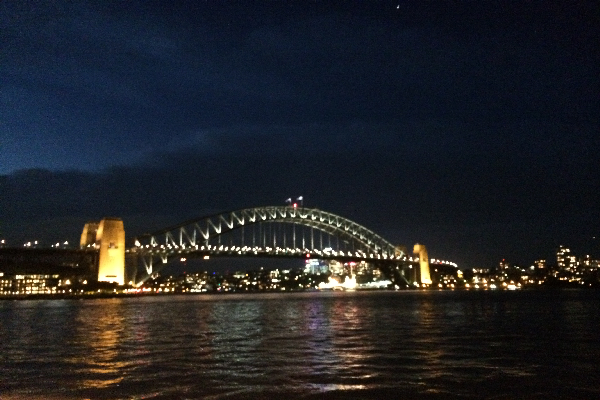
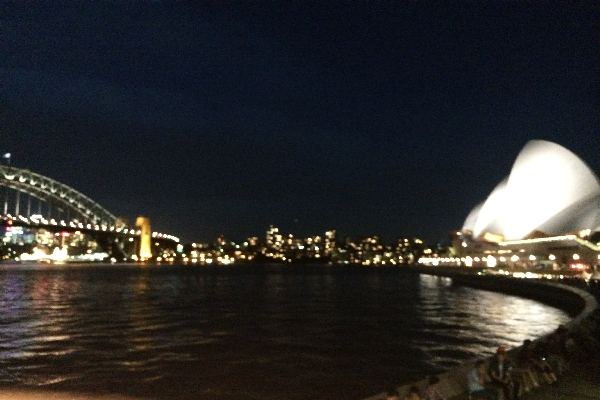
Harbor BridgeDarling HarborSydney Opera House sails
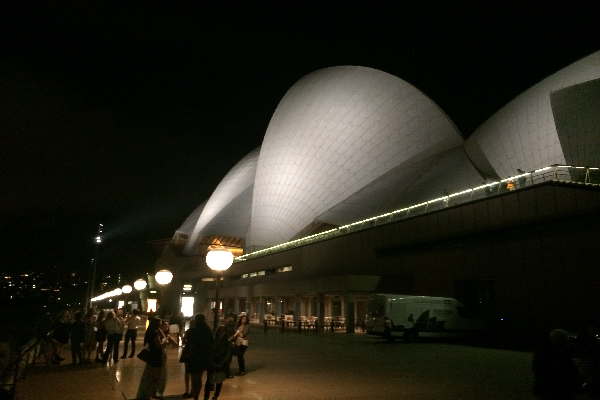
WOW, were we in for a surprise! Surprise and excitement is really an understatement!!! Why? Well not only would we see outside and inside of ‘The House’ we were treated to a whole day downtown Sydney, a fabulous dinner of fresh oysters and on-and-on, and tickets to a live performance of the world-class Sydney Orchestra and choir! Did I mention or emphasize enough the word, “LIVE’?!”
DESCRIPTION:
“My name is Maximus Decimus Meridius, commander of the Armies of the North, General of the Felix Legions and loyal servant to the TRUE emperor, Marcus Aurelius. Father to a murdered son, husband to a murdered wife. And I will have my vengeance, in this life or the next.”
Powerful, spine chilling and epic. Ridley Scott’s blockbuster, Gladiator, comes to Sydney for its world premiere, and the film score will be performed live in concert by the Sydney Symphony Orchestra and Lisa Gerrard.
The Sydney Opera House will transform into the Roman Coliseum as Hans Zimmer and Lisa Gerrard’s sweeping and dramatic score, among the all-time favorites, is brought to life by a full symphony orchestra while the movie is played in high definition live on the giant screen above.
Gladiator, winner of five Academy Awards, and a Golden Globe for Best Original Score – Motion Picture follows loyal Roman general Maximus Decimus Meridius (Russell Crowe – born in New Zealand, but now an Australian citizen), who is betrayed when the emperor’s ambitious son, Commodus (Joaquin Phoenix), murders his father and seizes the throne. His family dead, and reduced to slavery, Maximus rises through the ranks of the gladiatorial arena to avenge the murder of his family and his emperor.
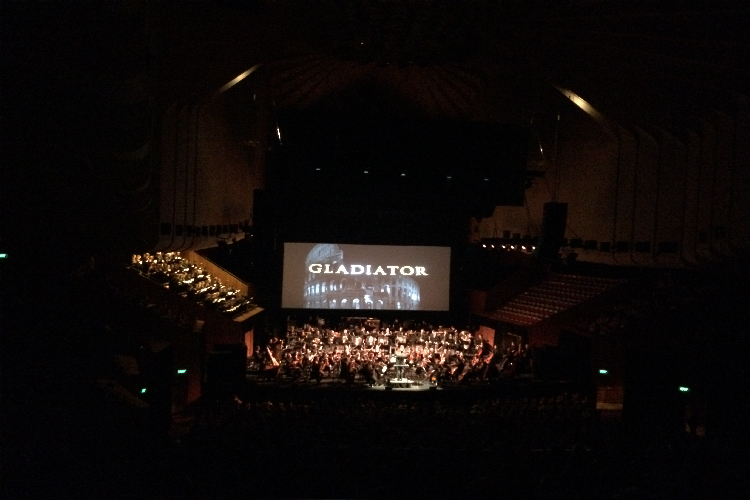
Now I have seen this movie a couple of times previously, but NEVER like this! There was an intermission where you could move about, get something to drink, go outside and etc., but OMG, by the start of the rest of the movie, I kind of got lost into the music itself and the vocals from the choir and the lead vocals from Lisa Gerrad that actually performed on the original soundtrack for the movie. The timing and the volume and the acoustics of the opera house were incredible!
Inside Sydney Opera House
The performance received and was much-well-deserved of a long, standing ovation! And by the way, the people of Australia generally and genuinely love to dress up when they go out. It was nice to see this!
Many years ago and even before my time, 🙂 the first movies were black and white and before the “talkies” (movies with sound), background music was performed by a sole pianist, some other musician, musicians or a small orchestra. Our experience at the Sydney Opera House was like a trip back in time. By this I mean, the old becoming new again. Obviously we cannot go to the movie, rent one or buy one and expect like “fries come with that,” to count on a live symphony and chorus to show up. But WOW, wouldn’t it be great if this was the common thing!
For me, I have never appreciated the importance of music in a film as much as I now do! And it was just beyond words to express my gratitude for this experience, for the incredible seats and to not only hear this music “live,” but to see the musicians as they played and the vocals as they were sung by such a world-class orchestra, choir and the vocalist that sung on the original soundtrack. All together, this was perhaps a lifetime experience being first in Australia, 2nd in this theater, 3rd to experience the movie/live music/visual display acoustics and to share this with my best friend and the love of my life! And I am thankful that Jonathan and Caitlin our ‘gifters,’ were here to join us and that they had some much needed time together. A big shout out to Wendy that took care of baby Felix, so they could enjoy date night! 🙂
I do apologize for some of the pictures above as they are not to my satisfaction. I have been having some difficulty with my camera recently. Also, the favorite digital media card for many professionals and me is compact flash. Unfortunately, it is a terrible design for downloading via a card reader to my computer. Before I left for our trip, I bought a new card reader so I could download my pictures to our laptop. Yesterday, the pins got bent and I had to get a new reader today. Today was raining so I spent it recouping my energy, and catching up with pictures and posts. I will need to address my camera with perhaps something new after we get home and I find some money or knock out all my teeth so the tooth fairy can visit me big time! 🙂
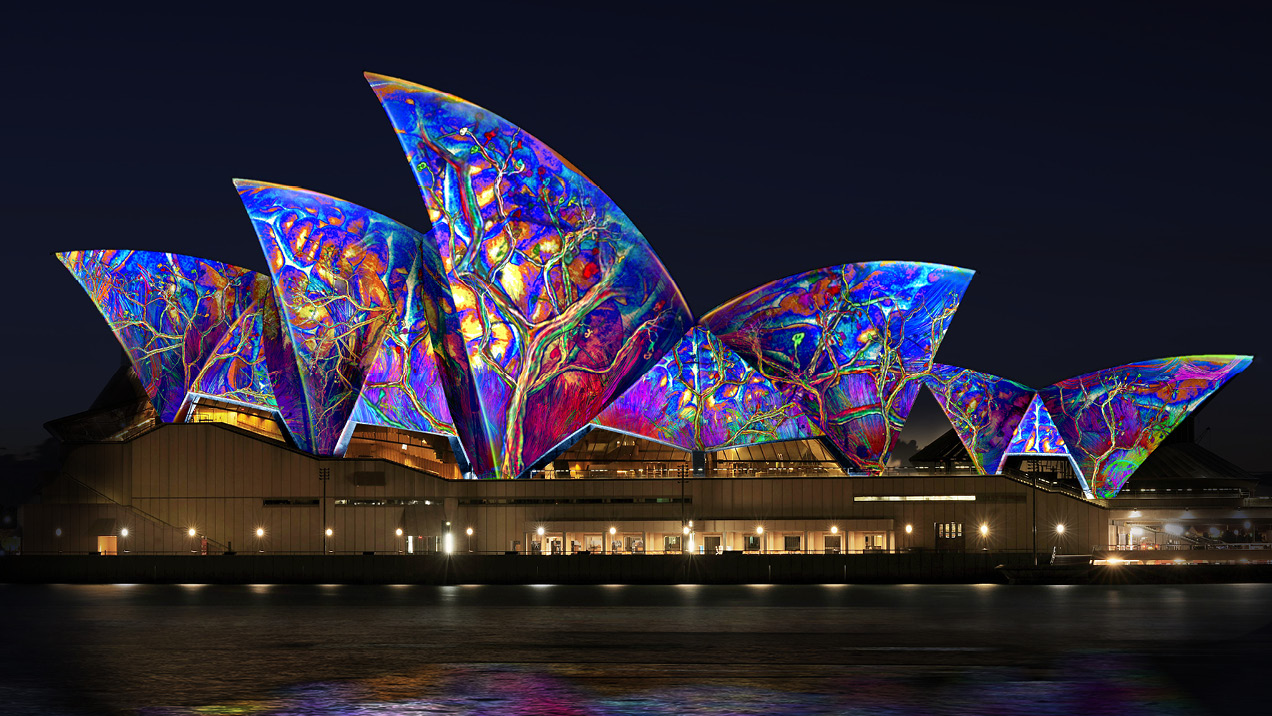
Sydney Opera House is a marvel of vision and construction. I believe I am correct in saying that each year, Sydney and Australia celebrate this icon in what is called, ‘The Lighting of the Sails.’ This year, the event starts on May 23 through June 9th, 2014. I would love to be here for this, but we will already be home. Each year it is different. I will close with a beautiful picture from http://vividlive.sydneyoperahouse.com/lighting-the-sails/?gclid=CO-Ph9Pixr0CFQUJvAodA7IAIg and two (2) YouTube videos, highlights from 2013 and 2012. If possible, crank up the volume and watch these FULL SCREEN! Enjoy! 🙂
Waltzing Matilda Australian unofficial National Anthem
Lyrics by
A.B. Paterson
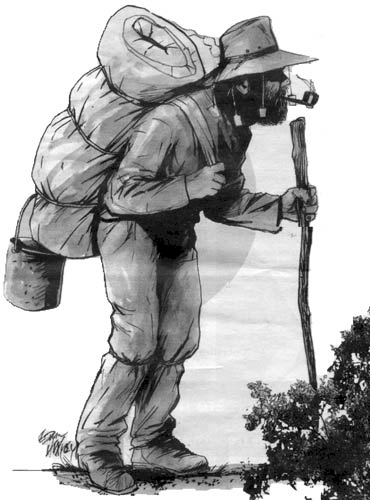
Swagman
Once a jolly swagman camped by a billabong,
Under the shade of a Coolibah tree,
And he sang as he watched and waited till his billy boil,
You’ll come a Waltzing Matilda with me.
Waltzing Matilda, Waltzing Matilda,
You’ll come a Waltzing Matilda with me,
And he sang as he watched and waited till his billy boil
You’ll come a Waltzing Matilda with me.
………………..
Down came a jumbuck to drink at that billabong
Up jumped the swagman and grabbed him with glee,
And he sang as he shoved that jumbuck in his tucker bag
You’ll come a Waltzing Matilda with me.
Waltzing Matilda, Waltzing Matilda,
You’ll come a Waltzing Matilda with me,
And he sang as he shoved that jumbuck in his tucker bag
You’ll come a Waltzing Matilda with me.
…………………
Up rode the squatter mounted on his thorough-bred
Down came the troopers One Two Three
Whose that jolly jumbuck you’ve got in your tucker bag
You’ll come a Waltzing Matilda with me.
Waltzing Matilda Waltzing Matilda
You’ll come a Waltzing Matilda with me
Whose that jolly jumbuck you’ve got in your tucker-bag
You’ll come a Waltzing Matilda with me.
………………….
Up jumped the swagman sprang in to the billabong
You’ll never catch me alive said he,
And his ghost may be heard as you pass by that billabong
You’ll come a Waltzing Matilda with me.
Waltzing Matilda Waltzing Matilda
You’ll come a Waltzing Matilda with me
And his ghost may be heard as you pass by that billabong
You’ll come a Waltzing Matilda with me.
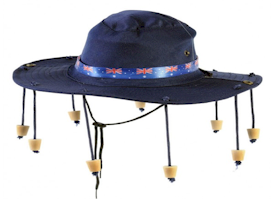
Swagman’s cork hat
Swagman a term describing an underclass of transient temporary workers, who traveled by foot from farm to farm carrying the traditional swag (bedroll). Also characteristic of swagman attire was a hat strung with corks to ward off flies. Kind of like a hobo or someone during the 1920-30’s during the depression when times were tough and work was hard to come by.
Billabong means drinking spot or pool in an intermittent stream. Because of the very dry conditions in out-back Australia, streams and rivers can often become dry leaving only a few water-holes where stock are able to drink
Coolibah tree is a type of Eucalyptus. It is is used to treat snake bites. The tree inhabits the arid and semi-arid open woodland areas of Australia. Its common name is of Aboriginal origin and Aborigines used part of the tree to treat snakebites.
billy boil is to make tea over a campfire
Waltzing Matilda is the knapsack on the back of a swagman. Where he goes, Maltilda waltzes with him.
Jumbuck is an Australian slang word for sheep
Tucker bag – a storage bag for food
Squatter in this instance means landowner
This tune is a traditional Scottish Melody and the words are by A. B. Paterson who is generally referred to as Banjo Paterson. He also wrote the Kookaburra Song.
I only thought we were in the country until we actually went into the country. It was a nice ride from Camden to Picton, New South Wales, Australia about 16 miles. We saw rolling hills and cows and sheep much like anyplace I have ever seen. If not for driving on the right side of the car and on the left side of the road, it all looked similar to anything I’ve ever seen. On occasion there would be a sign that read, “Stay in line unless overtaking,” meaning the center lane was for passing ONLY. Somehow, before we leave, I will snap a picture of the road sign for Kangaroo Crossing. But again, everything seemed quite the same. WOW, was I about to be surprised!
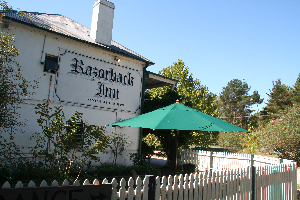
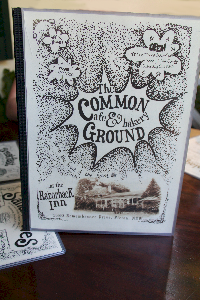
Our destination was the Razorback Inn, a quaint out-of-the-way place to eat that was established in 1849.
The Razorback InnMenu from ‘Common Gound’
The eatery is now run by a Christian Commune called, ‘Common Ground.’ They make their own clothes, live in the area, and run the restaurant including making all the food from scratch and natural and wholesome ingredients. A s delicious as the food was and as charming as the place was, this was not the most memorable experience, of this experience to me. It was in fact, the Bell Birds. Yes, that is what you read, what I wrote and what was meant! And as the name implies, the birds have some association with bells because, however they make this sound, they sound exactly like bells!!!!!!
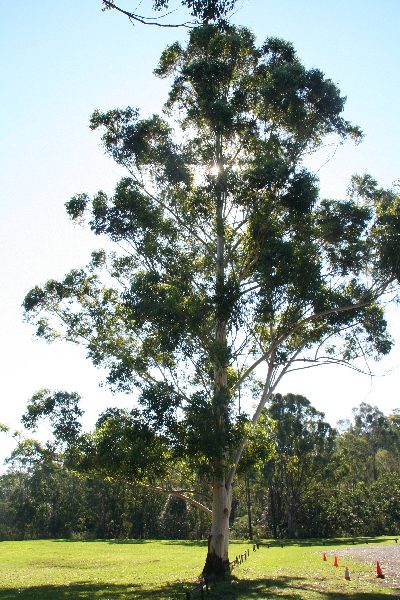
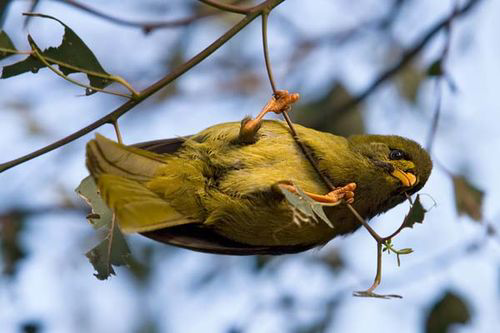
The Bell Bird or the Bell Miner (Manorina melanophrys), commonly known as the Bellbird, is a colonial honeyeater found in southeastern Australia. The common name refers to their bell-like call. “Miner” is an old alternative spelling of the word “myna” and is shared with other members of the genus Manerina. The birds feed almost exclusively on the dome-like coverings of certain psyllid bugs, referred to as “bell lerps,” that feed on ucalyptus sap from the leaves. The “bell lerps” make these domes from their own honeydew secretions in order to protect themselves from predators and the environment.
Bell miners live in large, complex social groups. Within each group there are subgroups consisting of several breeding pairs, but also including a number of birds who are not currently breeding. The non-breeders help in providing food for the young in all the nests in the subgroup, even though they are not necessarily closely related to them. The birds defend their colony area communally aggressively, excluding most other passerine species. They do this in order to protect their territory from other insect-eating birds that would eat the bell lerps on which they feed. Whenever the local forests die back due to increased lerp psyllid infestations, bell miners undergo a population boom.
The sound is beautiful and quite enchanting. It is difficult to believe that you are hearing these sounds and that they are made by birds. Adding to this difficulty is their size. They are so small and so fast, it is almost next to impossible to see them in the trees and capture them with a camera. The following pictures of the Bellbird are not mine. I was able to capture their unimaginable and unbelievable sound, but I found a wonderful video on Youtube, so I will use this to share with you.
Gum Tree (a species of eucalyptus) where the Bellbirds love to feed
Today, I would like you share with you, a mini-walkabout in the neighborhood. Let us just see visually, some house and shops within 2-3 blocks of where we are staying. But first, what is a “mini-walkabout?”
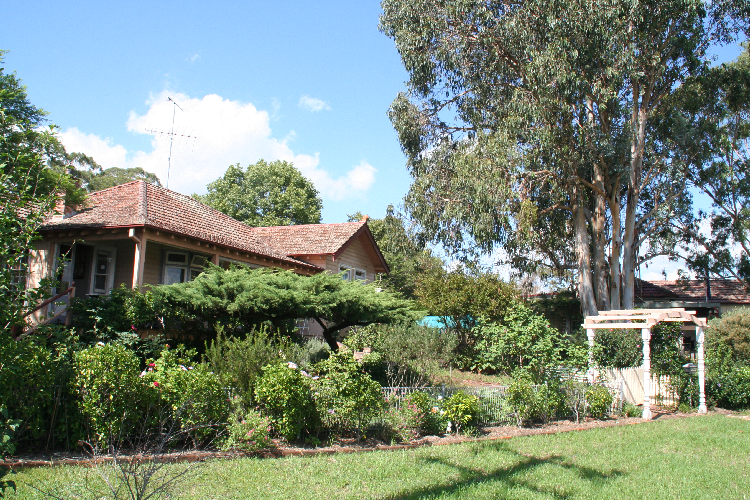
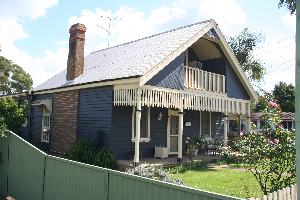
House on the corner of Little StreetPretty I
Walkaboutrefers to arite of passageduring which maleAustralian Aborigineswould undergo a journey during adolescence and live in the wilderness for a period as long as six months. In practice they would trace the paths, or ‘Songlines’ that their ancestors took, and imitate, in a fashion, their heroic deeds.Merriam-Webster Dictionary, however, identifies the noun as a 1908 coinage referring to “a short period of wandering bush life engaged in by an Australian Aborigine as an occasional interruption of regular work”, with the only mention of “spiritual journey” coming in a usage example from a latter-day travel writer.
To white employers, this urge to depart without notice (and reappear just as suddenly) was seen as something inherent in the Aboriginal nature, but the reasons may be more mundane: workers who wanted or needed to attend a ceremony or visit relatives did not accept employers’ control over such matters (especially since permission was generally hard to get).
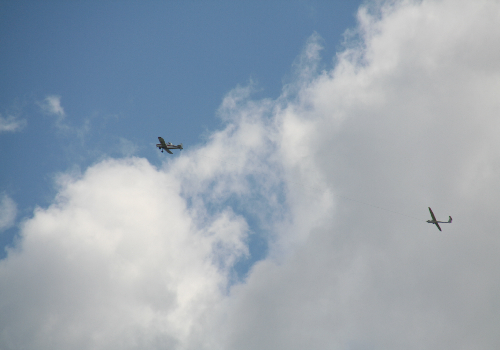
Plane & Glider
Another great possibility is that the Aborigine had no concept of time. If given a job to do, we may not completely finish the work in a day and would return at it’s end and continue the following day and so on until it is finished. The Aborigine would just take off and not return until the job was done.
Another Lovely Home
So, my mini-walkabout is just a short period of time, walking the neighborhood to see what I can find.
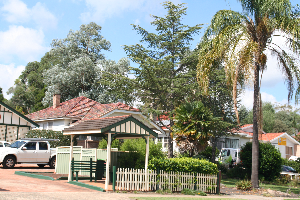
Most of the homes here have tile roofs and the rest have metal roofs. The ceilings inside most homes are around 8′ (eight feet) high. These construction materials and methods are to keep the interiors as cool as possible, for this area can reach temperatures as high as 115 degrees + Fahrenheit in peak summer.
Sometimes the relative humidity can be upwards of 90 percent, but at 115 degrees F., the heat burns off the humidity and it is a dry heat. This would be similar to the desert southwest in the United States. It is hard to imagine such beautiful and fragrant things surviving in such climates, but they seem to thrive.
Even though there are tropical birds, trees and plants here, it can become very dry and parched, due to lack of rain. Things could quickly turn brown, but as they say in Australia, “No Worries,” because everything adapts to these extremes and fluctuations.
In the United States we might freak out if our grass turns brown due to lack of rain and start watering like crazy. But in this area, brown can be normal, Again, “No Worries,” the rains will come again and everything will turn green again, almost instantly. At present, most everything is nice a green here, so we are happy about that.
The weather of their fall is between 70-80 F. by day and 65-68 F. at night. It has been very nice during the day and pleasant sleeping. The air is clean and fragrant although I seem to be allergic to something and have a little upper respiratory congestion. I am told that it never snows here, but it can get somewhat cold in the winter, but it is short-lived. They may have around five seasons here. Spring, early summer, late summer, fall and a short winter. I am sure this has to do with Australia’s position below the equator and I am told the hole in the ozone layer, its effects are greatly experienced here. I’m not sure of the accuracy of this, but I’ve heard 1 out of every 2 people experience some type of skin cancer. This country does have the highest rate of melanomas in the world. THE SUN IS HOT, AND BLINDING HERE! Cover up and where skin protection.
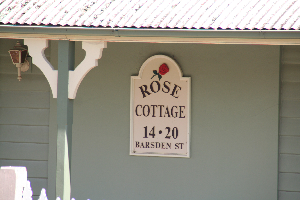
In another post, I mentioned that everything needed to live here, is within a short walking distance. I meant it! And actually, within seven minutes!
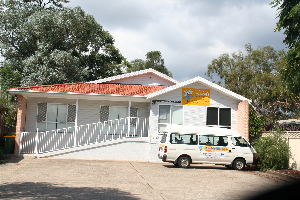
There is A family practice, Chiropractor, Orthopedic surgeon, a lawyer, hairstylist, Thai massage, a caterer, shed builder, engineer, daycare, a hospital, ambulance service, MRI & X-ray place for diagnostic images, cottages, houses, apartments and condos.
In a later post, I will share pictures of the downtown area. It’s only seven minutes from here on Little Street where we are staying. There you can get everything else you need!
And God forbid, there is even a funeral director in the neighborhood. 🙂
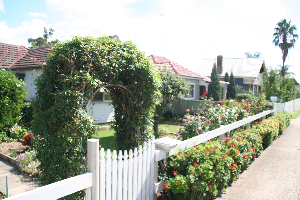
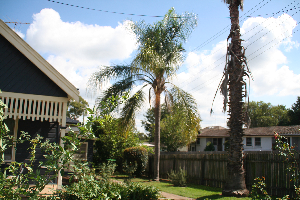
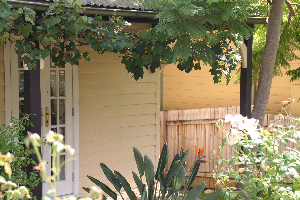
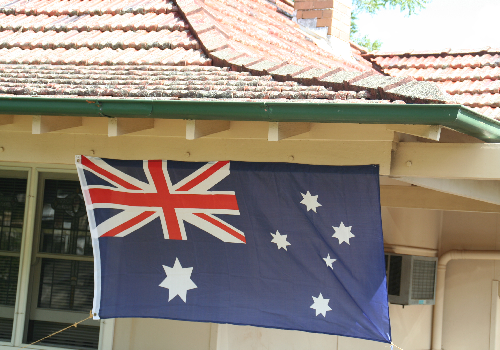
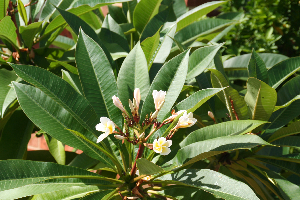
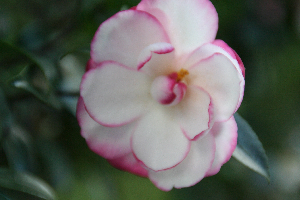
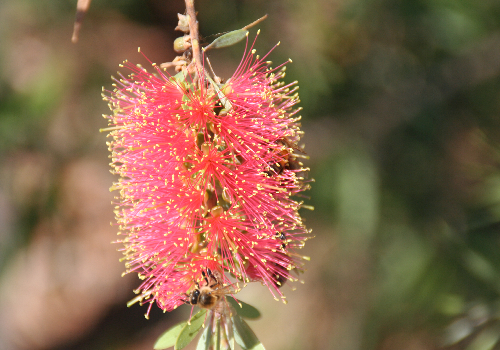
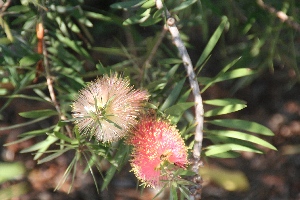
Another Lovely HomePalm treesPretty IIOffice IAussie PrideChildcarePretty IIIPretty IVCondosOffice IIOffice IIIBottle BrushBottle Brush IICottages and yes, lot’s of roses
Being in Australia, I thought I should share some music. What better songs than ‘Down Under’ by the 80’s Australian band, Men at Work and a childhood favorite, The Kookaburra Song by Marion Sinclair in 1932.
“Marion Sinclair wrote the song in 1932 for a contest being held by the Victorian Girl Guides.
The competition was for an ‘Australian round’ song. Her song, the Kookaburra Song won and was introduced by Marion at the World Jamboree in Frankston, Victoria in 1934. It was instantly a hit with the girls and has become a much loved song all over the world.
This is a fun children’s song. A gum tree is a name for the eucalyptus tree. There are more gum trees than any other kind of tree in Australia.
Lawsuit The Kookaburra song was involved in a copyright dispute with the Aussie band Men at Work over their song (I come from the land)”
The Song, ‘Come from the Land’ or simply ‘Down Under’ had a flute riff which the Australian Court ruled is an infringement of the copyrighted tune, ‘The Kookaburra Song.’ Despite the controversy between the two songs, and even former members of ‘Men at Work,’ both songs are wonderful and are shared here via YouTube videos. But first, what does a Kookaburra look and sound like?
Now for the lyrics and followed by the video of, ‘Down Under.’
Travelling in a fried-out Kombi
On a hippie trail, head full of zombie
I met a strange lady, she made me nervous
She took me in and gave me breakfast
And she said:
“Do you come from a land down under
Where women glow and men plunder
Can’t you hear, can’t you hear the thunder
You better run, you better take cover.”
Buying bread from a man in Brussels
He was six foot four and full of muscle
I said, “Do you speak-a my language?”
He just smiled and gave me a Vegemite sandwich
And he said:
“I come from a land down under
Where beer does flow and men chunder
Can’t you hear, can’t you hear the thunder
You better run, you better take cover.”
Lying in a den in Bombay
With a slack jaw, and not much to say
I said to the man, “Are you trying to tempt me?
Because I come from the land of plenty.”
And he said:
“Oh! Do you come from a land down under (oh yeah yeah)
Where women glow and men plunder
Can’t you hear, can’t you hear the thunder
You better run, you better take cover.”
Even though this video is about 14 years old and was filmed during the Olympics in 2000 in Australia, note both the familiar icons on stage and the enthusiasm of the crowd. They (the Aussies) loved this song, seem to connect to it and it was treated as an almost unauthorized national anthem. The term Down Under is a colloquialism referring to all things Australian, New Zealand or just one or the other. it is also known as “The Land Down Under” for its position in the southern hemisphere. This is because when one looks at a map in the most common way, Antarctica at the ‘bottom’ of the page, north appears to be “up” and south; “down.”
By the way, it rained this evening then cleared off. I am not a star specialist nor do I know the difference between the big and little dipper, but the sky was full of stars and what ever ‘dipper’ I was looking at, I have never seen it appear so close!
Anyway, despite the term “down under’s” wide usage, it is rarely used by Australians themselves, many of whom regard it with some derision. Nevertheless, Australians are not above using it themselves, as exemplified by Men at Work song “Down Under” which has become a patriotic rallying song. Australia’s most famous boxing champion, Kostya Tszyu, was nicknamed as “The Thunder From Down Under”.
According to Roger Ebert, “No film set in Australia is allowed to use the word Australia in its title where “Down Under” is an acceptable alternative. For example, we don’t get The Rescuers in Australia or Quigley in Australia.”
And now for the childhood favorite the world over, The Kookaburra Song.
The Kookaburra Song
By Marion Sinclair in 1932
Kookaburra sits on the old gum tree,
Merry merry king of the bush is he.
Laugh, Kookaburra, laugh, Kookaburra,
Gay your life must be!
Kookaburra sits on the old gum tree,
Eating all the gum drops he can see.
Stop Kookaburra, stop Kookaburra
Save some there for me!
Kookaburra sits on the old gum tree,
Counting all the monkeys he can see.
Laugh Kookaburra, laugh Kookaburra
That’s not a monkey, that’s me!
Here is another video that I thought you might also enjoy.
Guhday mates and mate-esses or Sheilas, from Australia 🙂
After the flight in from China and stowing our suitcases for the next month at Jonathan’s & Caitlin’s and baby Felix’s place in Camden, we instantly set out to discover this new country and experience what it has to share to share with you. It did not take long!
You might think, Oh yes, English speaking after Japanese, yes, yes, yes! But let me say this, you have to be a born and raised Australian to understand what some of them are saying sometimes! “Huh, was that English you just spoke????” 🙂
But yes, mostly it is nice to be able to understand and communicate in a language I am mostly familiar with.
Quite a contrast here to Japan which is just now starting to heat up into their spring. Here down under the equator where the water spins counter-clockwise, they are into their fall. Fall of 70-80 degrees Fahrenheit by day and mid sixties at night. It has been raining slightly for the last couple of days and everything looks lush and lovely. It was dry today and with the humidity of over 90%, it was hot, but we get a lot of the cool sea breezes.
Camden is about an hour from Sydney. It is considered the country. Those in the city call this the ‘bush’ but those that live here say the ‘bush’ is somewhere else. We are not far from where kangaroos roam freely. They are overpopulated and used for food. It is considered the reddest and leanest meat you can eat on the planet. Jonathan grilled some last night for us and well, it was DELICIOUS!
Camden is a quaint community of around 80,000 or so. People are genuinely helpful and friendly. Jonathan joined a community band and they had a concert this morning outside of the local library. Music is a universal love and they played many familiar tunes, even dedicating one to Susan, Jonathan’s Mom from the USA and another to a Belgium couple. We met for the first time a couple and they invited over to their home for lunch, coffee, tea, wine and desert. The world is, truly becoming, a global village. People really are, quite the same everywhere. We all just want to find our voice and our place in the world, love, be loved and live happily ever after, at least once in awhile. :).
Everything we need or could desire is only about a 7 minute walk to town. You walk past huge gum trees where they seem to be growing without bark. They are and the bark has just fallen off. They call the bark ‘fuel’ because, this is what it is used for. You pass home after home with mostly tile roofs (some metal), which are so built because, it keeps the homes cooler inside. It can get pretty hot here and stay this way for quite some time throughout the year. We are told that fall is the best time to be here and here, we are! But when it reaches a certain temperature, the humidity is just burnt off leaving the environment hot and dry, but again, cool breezes come in from the ocean regularly.
But oh, the birds of paradise! It is almost like a dream that we have traveled so many thousands of miles away from home to the other side of the world and now, almost to the bottom of the world. Our lunch hosts had recently been to the literal bottom of the world in Antarctica and showed us some incredible pictures of their time year. Their suggestion was to see the movie, ‘Happy Feet’ as the landscapes and the penguins including their personalities is just about how it really is. I also sometimes call new baby Felix, ‘Happy Feet,’ because he is always moving them like he’s dancing! 🙂
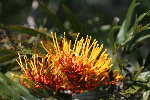
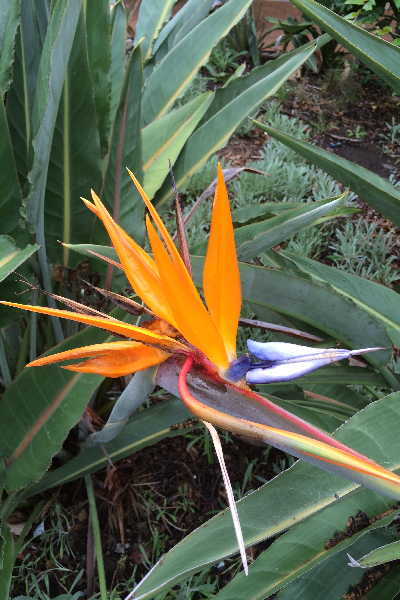
But anyway, birds of Paradise. For the most part where we are is, tropical. There are palm trees here and flowers and birds I have never seen except in picture books or movies. Some are similar to Florida USA or the country of Jamaica, but there are species here that exist no other place on earth. The streets are lined with color after color of sweet fragrant roses. But besides Lily of the Valley, my favorite flower is…
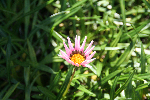
…Bird of Paradise
It was so nice to be able to snap this picture just a few minutes away by foot on my mini-walkabout. 🙂
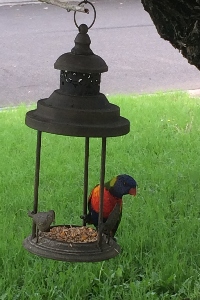
Then, there was another bird of paradise just outside the living room window where we are staying, eating at the feeder.
Another Bird of Paradise
I hope to be able to capture and record and share with you the beautiful bird-music by day and night be here just outside, as well as, the other birds of paradise that live here. I feel like I’m in paradise here. If I am not any more colorful or beautiful here, I am at least surrounded by color and beauty. Maybe, just maybe, some of Australia will wear off and into me? 🙂
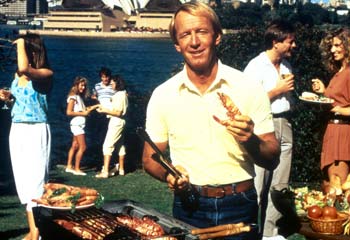
So waltz Matilda and tie me kangaroo down sport, we’d put some shrimp on the barbie for you, but I don’t really think they say this in Australia?
Paul Hogan, yep the same mate that played the lead in the ‘Crocodile Dundee’ movies
“Shrimp on the barbie” is an often-quoted phrase that originated in a series of television advertisements by the Australian Tourism Commission starring Paul Hogan from 1984 through to 1990. The actual quote spoken by Hogan is “I’ll slip an extra shrimp on the barbie for you”, and the actual slogan of the ad was “Come and say G’day”. It has since been used, along with some variations, to make reference to Australia in popular culture.”
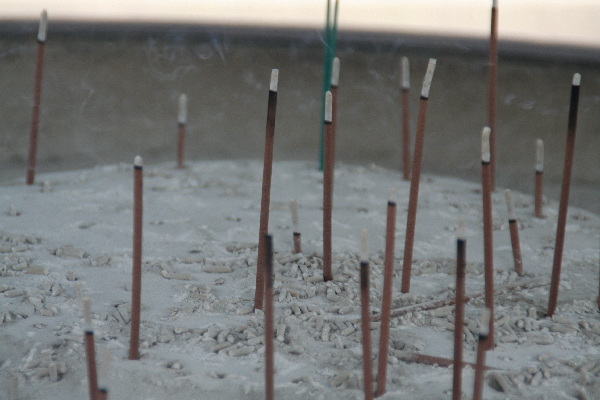
Perhaps there is no better way to title this post than by the word, purification and using a single picture showing incense burning? It will be the only picture given in the post, but as it is written, said and known, “A picture is worth a thousand words.” One picture here and we will just have to see how many words will follow. OK, maybe two pictures? 🙂
Purification
Burning incense may be thought of as having a spiritual and a practical implication, for both purification and cleanliness. Both the words are interchangeable or synonymous in Japan.
Every temple and shrine has an incense burner, sticks of incense to share and some means to light them to burn. Throughout Japan and our travels here, the lovely fragrance of incense fills the air and is seen burning as sticks and sometimes like clouds, clouds of smoke rising in the sky. Indeed, this does have spiritual significance and is symbolic of purification. Items you purchase in Japan, often have the aroma of incense. And I just love the smell of it and the surprise of it upon my senses when least expected. Whether for spiritual reasons or not, I would love the West adopting this custom to make our countries, communities, shops and homes fragrant and conducive to the promotion of peace and harmony, it seems to bring with it as it burns and purifies the world around us, our consciousness and the attitudes we harbor within us.
Purification II
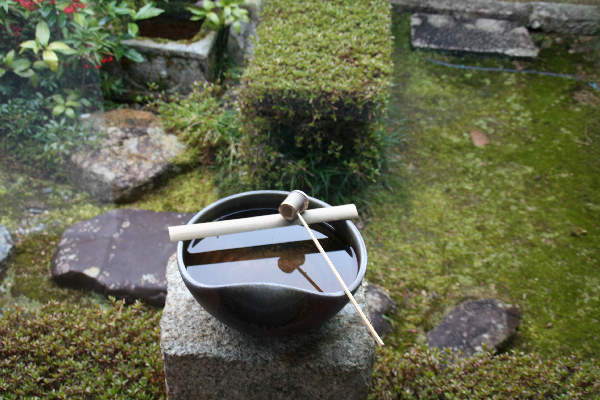
Water is important in Japan for both spiritual and the practical application of purification. There is a lot of washing of hands in Japan especially when entering in to a temple or shrine area. Warm moist towels are common everywhere in restaurants, tea houses and in homes prior to the consumption of a meal, to freshen your face and hands. One side of the towel is used for your face and the other for your hands. For the purpose of cleanliness or purification, it is extremely important not to commingle. Another example of this is understood from the picture of the water bowl above. The long-handled dipper is usually made out of bamboo. It’s purpose is to keep your hands as far away from the pure water as is possible. You dip the cup into the water and pour some over one hand (outside of the bowl), change hands and pour more over the other hand. The last step is to pour the last remaining water over the handle where your hand was to clean it for the next person and then placing the dipper back to its original state as shown in the picture. The purpose of this again, is for purification. The cup stays clean, the handle stays clean for the next person, water in the bowl stays clean and nothing is supposed to commingle.
Purification and cleanliness is seen and observed throughout Japan. It is not a mere novelty or even just a tradition or a custom, it is a way of life here. Cabdrivers, bus drivers and train personnel all wear clean and freshly pressed suits and ties or uniforms. The vehicles they drive or work in are always clean inside and out and void of trash and debris. Efforts to remove trash and debris are kept at a minimum because, people in Japan for the most part, just do not leave their trash. For the longest time, I could not understand why it is next to impossible to find public trashcans anywhere I have been in Japan. Now I think I might? The Japanese do not encourage the placing of trash in public. They want their surroundings to be clean and to reflect their desire for peace and harmony. Trash is not solely the responsibility of refuse collectors, it is everyone’s! Also, along with what is to follow here, in Japan, space is just limited so there is a conservative aspect to cleanliness-purification.
There is an order to order here. People generally only smoke in designated areas inside and out and generally, only while standing. There is a lot of bowing that takes place here – towards places of significance and out of respect for others.
Bathrooms in homes, businesses and shops are always separated into three parts and are compact areas. I humorously suppose when England refers to a bathroom as a water closet (WC), they must be talking about Japanese toilet rooms. These are are not much bigger than a closet. 🙂
Toilets have a tank for filling the flushed bowl and it fills at the top from a curved pipe that acts like a waterfall. I suppose you could rinse your hands in this clean water, but I would have a personal issue with washing my hands in toilet water, even if it is clean. Besides, the sink and laundry facilities are in another separate room, next to the shower and bathing room.
The shower and bath are in the same room but they are separate. You turn on the hot & cold water to adjust to your desired temperature then turn a lever to activate just the shower. A custom of the Japaneses is to fill the tub with hot water and shower first getting clean as possible, then soak in the tub for a few minutes. This same tub may be shared by all the members of a family. The water in the tub is already clean, each person has already washed in the shower and well, water is not to be wasted. Still, space is limited in Japanese homes so public bath houses, a sento, are not only popular here, they too, are a way of life.
A sento allows for much more space to stretch out, more features than are found in a typical home and are a way for families and friends to spend more time together. Most people here visit a sento at least once or twice a week at around about $7.00 per visit. Some do this daily for the added extra space and the features offered by the sento. These bath houses just relax you after a hard day or a week’s built-up stress.
At first, even though men and women bathe separately, one’s first experience at a sento can be a little intimidating, because in Japan, you bathe nude, just like everyone else. Fathers bring their young sons, other male family members and I suppose, a friend or neighbor’s child? And the same goes here for women. Public nudity is no big deal in Japan, only to westerners I guess like I once was somewhat uncomfortable the first time. But as the saying goes, “When in Rome, do as the Romans do.” However, body piercings and tattoos are not allowed inside a sento. The only focus the Japanese want in a sento is, the result of the experience, not looking at anyone’s body. The result of the experience? You feel great, clam, refreshed, relaxed and ready to conquer whatever life throws your way.
For the price of admission, you are given a locker to store your stuff and a key which you can either wear around your ankle or wrist. You are given another wrist or anklet bracelet to purchase anything you might need. Most people bring their own towels to save money or they can be rented. Shampoo, conditioner and body soap are pump containers and are supplied by the sento. They are fragrant and really good products, for your skin and hair.
First, you enter the bathing stations which have the pump dispensers, a mirror, a small bucket and plastic seat with a hole in the top. You rinse out the bowl and the rinse off the seat then sit and wash yourself as clean as is possible. Then you clean the bucket and the seat for the next person. Now one is ready to enter the bathing facilities, clean!
There is a hot sauna (one of my favorites). When entering, again, you clean the seat and area where you will be sitting and again, when you leave. In this hot, steamy environment, there is a large container of course salt. The salt is rubbed and scrubbed all over your body except for the face, any sensitive areas or obviously not any cut or wounded area as the salt would burn. The salt removes many callouses and polishes your skin smooth. It is an incredible and wonderful feeling. You stay in as long as you desire then move on to the next area. This could be a dry sauna, cold or hot tubs, individual or groups. There are fountain areas and waterfalls. Some areas are surrounded by walls with no ceiling so you can sort of be outside and seen the moon and stars and feel the cool night breeze on your heated skin.
There was one area where you lay flat on a constant stream of warm water and your head is slightly raised on a rectangle block. You place the rolled towel you have been carrying throughout that is wet from constant cleaning, rinsing and drying under your head for extra support. I call this the horizontal stretching pool as this is what it is does, stretches out your spinal column and makes your possibly otherwise aching or sore back from a lot of walking, just feel terrific.
There was a mineral warm pool of minerals and ginseng and etc. designed to relax, refresh and rejuvenate you. These baths are changed from time to time with other minerals etc. which are supposed to do give other therapeutic benefits and give variety. On two corners of this bath is a series of electrical pulses that have different cycles and degrees of duration and intensity. One side is mild and the other corner is more robust. It’ like getting a lower back massage with magic fingers.
There are many other areas we did not have time to explore. We chose to be here only for an hour, but I suppose if you wanted to, one could stay all day or night until they closed. The facility is constantly being monitored, inspected and cleaned for the maximum amount of efficiency, purity and cleanliness that it humanly possible. The Japanese have been using sentos or public baths for centuries, so they are masters at it!
Men and women, young and old come out of their separated areas fully refreshed and clothed and meet in the center area to share in food, fun, frivolity, conversation and drink. Special (private areas) are stationed all along the perimeter of the central common area. These are for more specialized areas like a special massage, yoga and etc.
But the whole point I am trying to make here is that in about 1 hours time, you leave the sento just feeling great!! 🙂
You leave the facility, turn in your bracelets, pay any charges, pickup and and put on your shoes and off you go into the night air FULLY SMILED AND RECHARGED. I would love to have a sento at home where we live, but due to our western thinking about public nudity and perverts lurking almost everywhere in the United States, this will probably never happen. Still, I would love this to be possible along with importing the Japanese art of barbering and so I’m told, hair styling for you ladies.
I mentioned shoes earlier. Most rooms that I have seen in Japanese homes are separated with raised thresholds when leaving one area into the next. As you enter through the front door, you immediately remove your shoes and leave them by the door. There is a step up to enter the hallway. There you find sandals/slippers and place them onto your feet. This act keeps dust and debris confined and kept to a minimum so the next area you enter remains, relatively clean. Every entrance to every room has a raised threshold, keeping each room clean from the others, as much as possible. The toilet area have their own set of shared slippers/sandals. You remove the ones on your feet and leave them outside the door while slipping on the ones in the toilet area and leaving them there when you leave. It may be possible for a man to stand at the toilet to urinate, but it would be pretty difficult to do, so is is preferred and appreciated if all remain seated. Japanese people are for the most part, pretty non-confrontational. They do not like to offend or confront. I have even seen a little wall mounted picture with visual descriptive images and instructions in French, to make the point that men should remain seated. 🙂
We of the west with our large bathrooms, wall to wall carpeting and one level surface between rooms might think the Japanese way is all fuss, much-ado-about-nothing and unnecessary? You might think the same about this post and its length of time to write it and to read it? But the entire subject and purpose of it is, purification.
The Japanese work very hard and quite often have limited time, space and resources. Adopting some of their customs in the west for a practical reason is that, if our stuff just stays cleaner, we may actually use less time for cleaning and have more for living life. And I may have discovered a practical reason for bowing too? If you change your shoes/sandals/slippers a lot between rooms, as you bow or bend over, you can turn your shoes in the direction of your exit so it’s easier to slip them on and go! 🙂
This may be my last post until we reach Australia for the 2nd leg of our travels. Susan is by far the better journal-er as she posts a series of pictures and brief overall descriptions on her Facebook time-line. I am, obviously more wordy or be it, verbose. But I am a visual learner and a post-processor. It take me a long time to process the incredible amount of information and experiences I have had here in Japan. Why just yesterday, I believe I took over 800 photographs. And that is just one day and does not even begin to suggest all the places we have been to or seen. It will take me some time to process all this information, edit, choose or discard the pictures taken and to decide what to do with them. But I will share something with you at some time later. At the present and I’m sure while in Australia it will be just, experience-point-and shoot! 🙂
I am told that the best way to learn a new language is immersion. By immersing yourself into the culture and being constantly exposed to the hearing, seeing and reading the language, you have a great opportunity to pick it up rather quickly. Although I did not come here to learn the language, but have picked up some words, I have for the most part, immersed myself in the Japanese culture. This is not our first time in Japan and perhaps some of my previous experience spilled over into me, this time. I was paid a very nice recently by Yoshi, the father of of Saiko and father-in-law of of Chris, whom we came here to see and his their new child Kai. Yoshi in speaking about me told Chris, “He (me) takes Japan with ease.” Whether this is by nature or something that has just evolved in me, I must make a confession.
In 2006 (our first trip to Japan), if I was not prejudiced, I at least harbored a lot of stereotypical attitudes about the Japanese and the culture and especially their food. But I am by nature, curious and generally like people. Still, despite my profound experiences here, I am quite sure that there are many things I would never try, repeat or eat in my own country. Food like the title of this post if pure, it is a fresh as is humanly possible, free of additives and chemicals often found in the United States. At home, I can hardly even drink a single beer or glass of wine without falling asleep. I am very selective about eating fish at home because, if I can smell it, I’m not eating it, Here in Japan like Yoshi told Chris, I seem to take Japan with ease and it has seemed to be genial towards me. If this is immersion than, it has served me well and I only hope that it continues in Australia.
When you really think about it, prejudices, fears, intimidation, and stereotypes are really just the consequences of ignorance. If memory serves me correctly, the rising awe inspiring pagodas are symbols of wisdom. The carry the message, ‘Come with an open mind!’
Where ever I have had the blessing to go in my life and the privildge to share with others, I have found people to have more in common then we might first believe.
From my point of view, the main difference between the United States and every other person in the world is that we put into writing, into our form of government that, “all men are created equal and that they are endowed by their creator with certain unalienable rights that among these are…-
…Life, Liberty and the Pursuit of happiness.”
excerpt from: The Declaration of Independence
And those those certain truths are universal we all hold and that about purification!
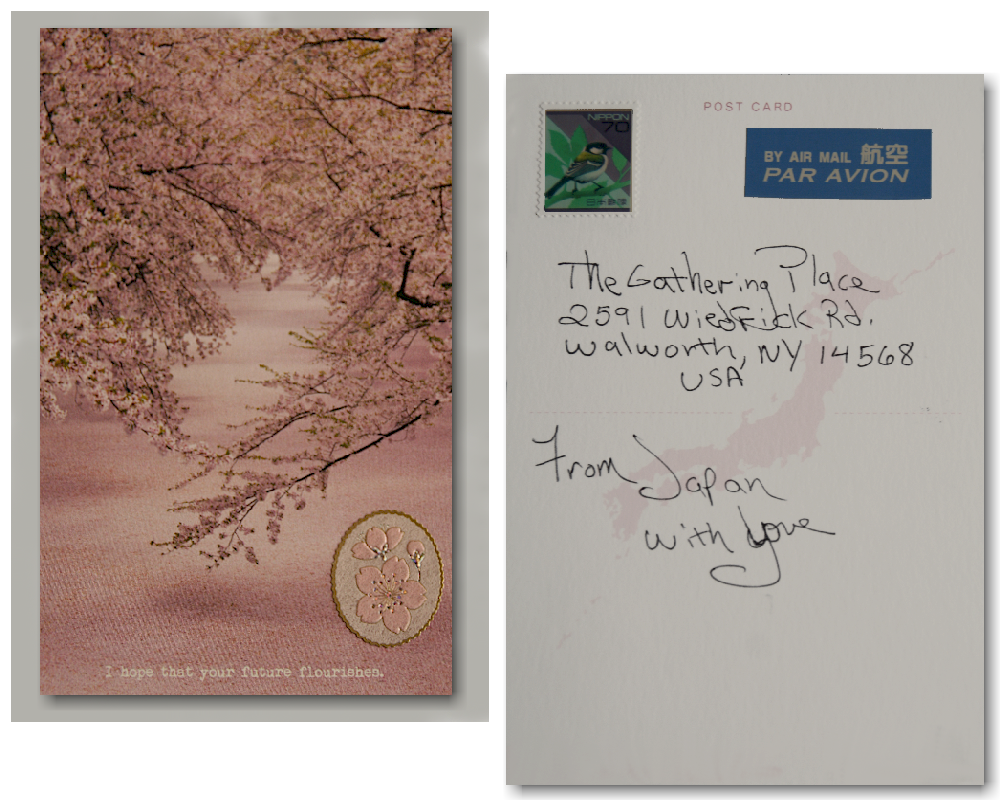
For those of you for whatever reason(s) are not with us traveling in Japan and soon, Australia, we sent you a card. Hope you like and it is to celebrate the Spring Equinox 3/21/14. Hope the weather is getting better where you are! Think Spring!!! 🙂
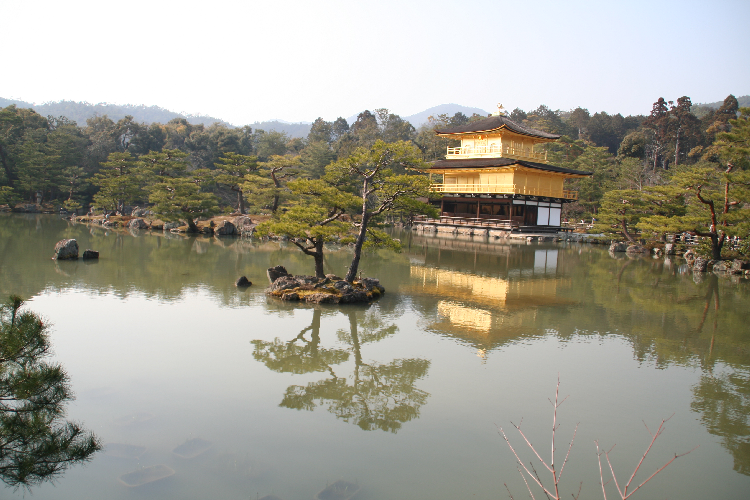
Actually this post is not about Golden Pond, but a Golden Palace on a pond or be it, a small lake. But one has to name something, something and it seemed like a good idea at the time.
I must digress here to state what may or may not be obvious. These posts from our travels are neither a journal or in day by day, hour by hour chronological order. Part of this is due to my love of words and my tendency to write many of them. I do try to think of others in that I ask myself, what would I want to see or want to learn about while in Japan? I try to keep these posts interesting and informative to the best of my ability.
Another issue is that even in the short time that we have been here, we have done so much; seen so many things. I have taken lots of pictures and when we return, I will just have to decide on what to do with them. Lastly, there is the lack of WIFI in Japan. With iPhones, an iPad and a laptop with us, we certainly have the means to post content and pictures in several ways, but outside of where we are staying, there is no internet access.
Oh, there are, WIFI access points everywhere and most are secured networks which require a password. In order to use one of these you have to pay for them by the day or even the month. In order to do that, you need to be living here basically, as the Japanese are not too particularly fond of sharing their WIFI or broadband internet with foreigners. Many Japanese have WIFI at home for their devices. Their smartphones are tied to a prepaid (monthly) satellite service so that they can use their phones, pads, and devices pretty much wherever they are. I have seen several people on trains here, communicating over the internet through social media like Facebook. But, alas for us, we have to wait until we get back to where we are staying to access the internet and use services that require WIFI. I do not know what it will be like in Australia, but we are soon to find out.
But as you walk in Kyoto, soon you find yourself within the woods and then suddenly in the distance, you see this beautiful and phenomenal sight with a background of nature like a picture frame as if made to feature it. Here is the Golden Palace, actually overlaid with 24k gold.
The Golden Palace
I’m not sure why the bottom first section is not gold, perhaps so that no one could scrape it from the structure?
It is beautiful, but I am more awestruck at how it blends in with nature and the angles and the way in which such structures are built.
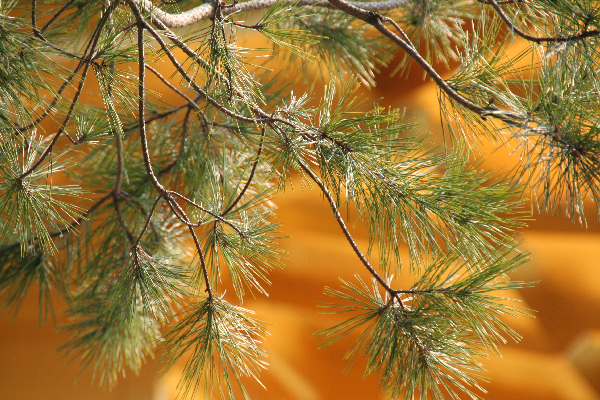
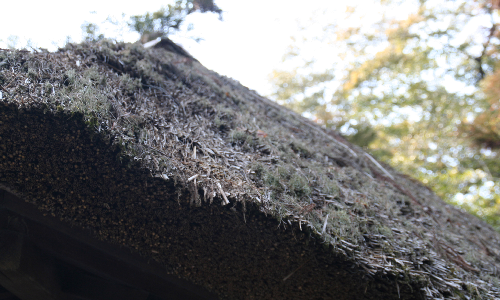
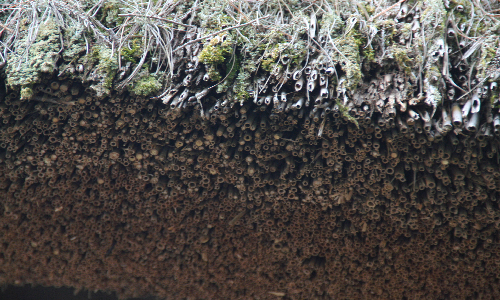
The harmony of nature and the work wrought of humansRoof constructionNatural reed roof
The material again is from nature and the construction by human binds hollow reed so tightly, it insulates and protects against insects, wind, snow and rain while keeping the structure warm in the colder months and cool in the warmer months.
Yes, it is the harmony of nature’s art and the art of humans which make so many things so beautiful in Japan! Though to build such a structure which still stands after so many centuries was long and difficult, naming things in Japan is often short and simple! These are contrasts or more like understatements, figures of speech that call our attention.
A golden palace on a pond is, what this is, but the words cannot describe its effects and affects upon the senses when they are first experienced and long remembered! The words are almost like a haiku poem of just three lines and 17 syllables, but hold great depth of meaning and purpose. But stated so simply and so matter-of-fact, they seem not able to convey the difficulty to master the art form and construct them like, the golden palace. It is just there as if it is supposed to be and always was, waiting only on you and I to discover its truths.
Oh sure, this place is a tourist attraction and many people come here to see it, both foreigners and the Japanese. And why not, wouldn’t you want to see a palace of gold on a pond, we did! So, perhaps this was an intention of its builders that even after the deaths of those it was built for, people would continue to be drawn here; support it and etc. But it’s importance is so much more to the Japanese and to me! It is an example of the art and harmony of, nature and humans simply drawing others to it as if calling out and stating simply; beautifully; poetically, here is…
…The Golden Palace on the Pond
I will close this post with another example of this understating and harmonious blending of the art of nature and humans.
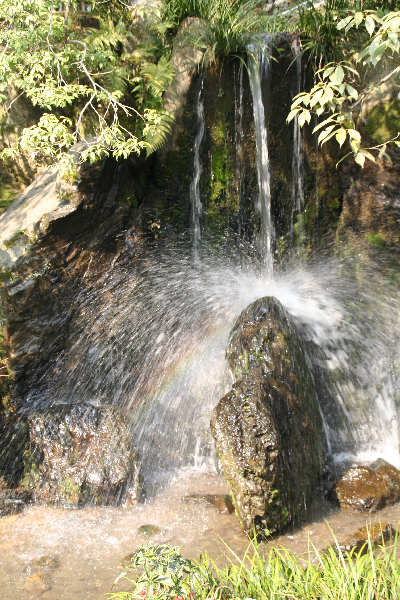
Leaping Fish Fountain
This fountain is also part of the compound of the Golden Palace. The up righted or vertical stone looks like a fish that is leaping up the fountain. Notice the rainbow! 🙂